Fertility and Trying to Conceive: The Complete Guide
How conception works, how to find your fertile window, how long it usually takes, when to get help, and what treatment involves, with frank talk about family pressure and the emotional side.

TL;DR: Most couples conceive within a year of regular unprotected sex, and your best chances are in the few days before ovulation and the day itself. Start folic acid before you try, and get a preconception check. See a clinician after a year of trying, sooner if you are in your mid-30s or older, and straight away if your periods are irregular or absent or you have a known condition. Infertility affects about one in six people worldwide, it can involve the man as much as the woman, and many causes have treatment.
Trying for a baby can start with excitement and slowly fill with questions. Why is it taking so long? Am I doing something wrong? Why does every aunt at every family gathering ask when the baby is coming? This guide walks through the whole picture in order: how conception works, how to time it, how to prepare your body, how long it usually takes, and what happens if it does not happen as quickly as you hoped. It is written for African women at home and abroad, where the pressure to conceive can be heavy and the blame too often lands on the woman alone. Each section gives you the essentials and then points to a deeper post when you want more.
How does conception work?
Conception needs a chain of events to line up. One of your ovaries releases an egg, usually around 10 to 16 days before your next period, according to the NHS. The egg travels into a fallopian tube, where it can meet sperm and be fertilised. The fertilised egg then moves down to the womb and implants in its lining.
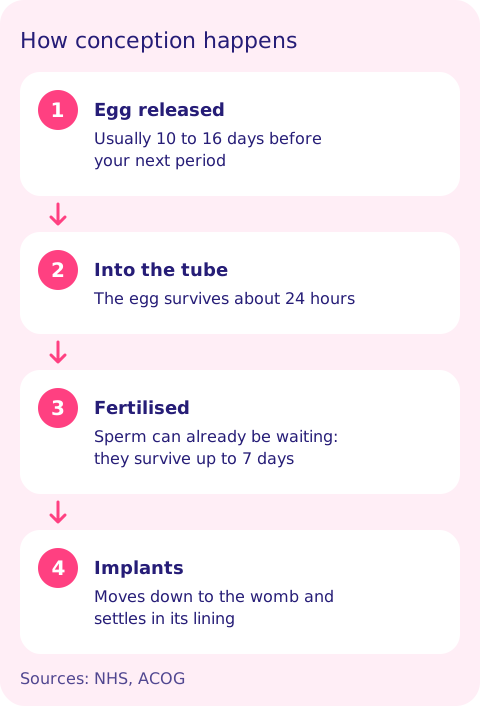
Conception is a chain of four steps, and the timing of each one matters.
The timing is tight. An egg survives only about 24 hours after ovulation, according to ACOG, but the NHS says sperm can survive in the fallopian tubes for up to 7 days after sex. That is why sex in the days before ovulation counts so much: sperm can already be waiting when the egg arrives. Our fertility tips for getting pregnant explains this in more detail, and understanding your cycle covers what your hormones are doing across the month.
When is your fertile window?
Your fertile window is the few days each cycle when sex is most likely to lead to pregnancy: roughly the five days before ovulation and the day of ovulation itself, a six-day window found in a landmark study in the New England Journal of Medicine. The NHS says women with a regular 28-day cycle are likely to be fertile around day 14, but this does not apply to cycles that are longer or shorter, so the window moves.
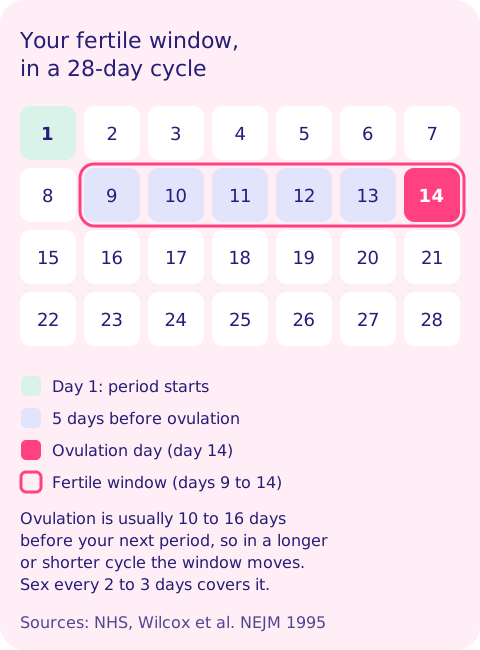
An example 28-day cycle. In your own cycle, count back from your next period rather than forward from day 1.
You can find it in a few ways, which ACOG describes. Just before ovulation, cervical mucus increases and becomes thin and slippery. Your resting body temperature rises slightly around ovulation and stays higher until your next period, which helps you see the pattern over several months of tracking. You do not have to time things perfectly, though. The NHS describes regular unprotected sex as every 2 to 3 days, which covers the window without turning your relationship into a calendar. Our post on the fertile window and ovulation goes through each tracking method.
How should you prepare your body before trying?
Preconception care is about getting your body ready before a pregnancy starts, because some of the most important development happens before many women know they are pregnant. The NHS advises taking 400 micrograms of folic acid every day, ideally from about three months before you conceive, to lower the risk of neural tube problems such as spina bifida. Some women need a higher 5 mg dose on prescription, including those with diabetes or sickle cell disease.
The NHS also recommends checking you are protected against rubella with the MMR vaccine, keeping cervical screening up to date, and getting tested for sexually transmitted infections if there is any chance you or your partner have one. If you take regular medicines, or live with a condition such as diabetes, high blood pressure, epilepsy or a thyroid problem, ask your doctor to review your plan before you start trying. The NHS also suggests stopping smoking, not drinking alcohol, eating a healthy diet and trying to keep to a healthy weight, since a weight that is too low or too high can make it harder to get pregnant.
Knowing your genotype, and your partner's, matters in many African families. If you both carry the sickle cell gene, each child has a 1 in 4 chance of inheriting sickle cell disease, according to the US National Institutes of Health, which we explain in sickle cell disease and women's health. Here is the short version to work through:
- Folic acid, 400 micrograms a day, ideally from about three months before trying, or 5 mg on prescription if you have diabetes or sickle cell disease.
- Vitamin D, A daily supplement, as the NHS advises for anyone trying to get pregnant.
- Rubella protection, Check you have had the MMR vaccine.
- Cervical screening, Make sure it is up to date.
- STI testing, For both partners if there is any chance of an infection.
- Medicines review, Talk to your doctor if you take regular medicines or live with a long-term condition.
- Genotype, Know yours and your partner's.
- Habits, Stop smoking, avoid alcohol, eat well and aim for a healthy weight.
Our preconception checklist goes into each step in more detail.
How long does it usually take to get pregnant?
Longer than most people expect, and that is normal. For a healthy couple in their 20s or early 30s, the chance of pregnancy in any one cycle is about 25 to 30 percent, according to ACOG. Over time those chances add up: the NHS says more than 8 in 10 couples, where the woman is under 40, conceive within a year of regular unprotected sex.
Age is the biggest single factor. Fertility starts to fall in a woman's early 30s and faster after the mid-30s, and ACOG notes that by 40 the chance per cycle drops below 10 percent. Men's fertility also declines with age, though less predictably. This does not mean pregnancy after 35 is unlikely. Many women conceive in their late 30s and beyond. It means it may take longer, and it is wise to seek help sooner.
When should you see a doctor about fertility?
NHS guidance is to see a doctor if you have not conceived after a year of regular unprotected sex, and sooner if you are 36 or older, or have any reason to be concerned. The UK clinical guideline, NICE NG257, says both partners should be offered assessment after a year of trying, and that you should be offered a specialist referral as soon as you present if you are 36 or over, or if either partner has a suspected or known cause of infertility or a history of risk factors. In the US, ACOG suggests an evaluation after six months if you are over 35, and straight away if you are over 40.
That means you should not wait a full year if you have irregular or absent periods, a known condition such as PCOS, endometriosis or fibroids, a history of pelvic infection, or if your partner has had testicular problems or cancer treatment. Both partners should be checked from the start. The NHS describes blood tests to check ovulation and hormones and scans or tests to look at the womb and tubes for the woman, and a semen analysis for the man.
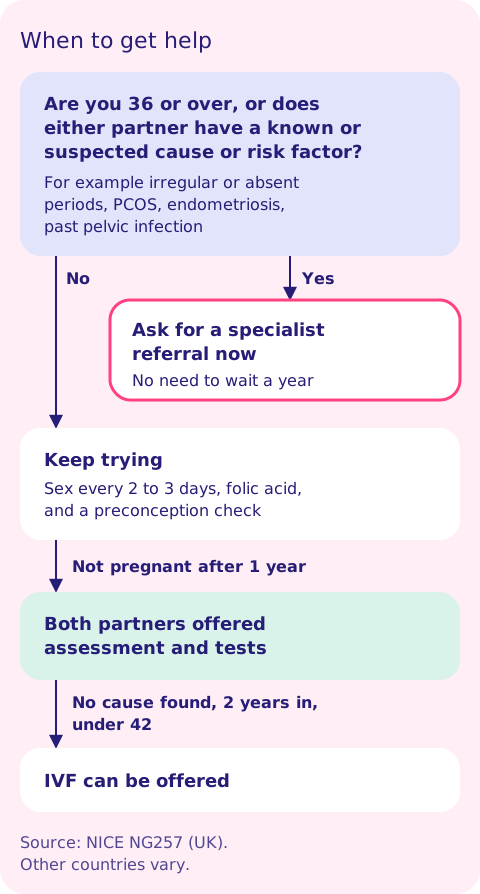
When to get help, following the UK NICE guideline. Guidance in other countries may differ.
Our post on when to see a fertility specialist explains what the first appointments involve and the questions to ask.
What causes fertility problems in women?
The WHO estimates that about one in every six people of reproductive age experiences infertility in their lifetime. In women, the most common cause is a problem with ovulation, where an egg is not released every cycle or at all. The NHS lists PCOS, thyroid problems and premature ovarian failure among the causes. Fibroids, which are common in Black women, can affect implantation depending on their size and position, and endometriosis can damage the tubes and ovaries.
Blocked fallopian tubes are another important cause. The WHO notes that blocked tubes can be caused by untreated sexually transmitted infections, or by complications of unsafe abortion, postpartum infection or pelvic surgery. Chlamydia and gonorrhoea often have no symptoms, which is why testing matters even if you feel well. The NHS says that for 1 in 4 couples, no cause can be identified. Read more in our guides to endometriosis, fibroids, thyroid health and STI symptoms, prevention and treatment. If you live with diabetes, diabetes and your periods, thrush, sex and fertility covers how blood sugar affects conception and pregnancy planning.
What about male fertility?
Fertility is a couple's question, not a woman's burden. The WHO is clear that infertility can come from the male or the female reproductive system, and that women are often perceived to be the infertile partner whether or not they are. In men, the most common causes are problems with ejaculating semen, low or absent sperm, or sperm with an abnormal shape or poor movement. The NHS adds that a raised temperature around the scrotum is linked to lower semen quality, and that infections, injury or surgery to the testicles, some medicines, and long-term anabolic steroid use can all affect sperm.
In many African families, a man may refuse testing because it feels like an attack on his manhood, leaving the woman to go through scan after scan alone. A semen analysis is simple, painless and often the quickest test in the whole process. Asking your partner to do it early is not an accusation. It is how you save months. Our post on male fertility explains what the test looks at and what helps.
How does PCOS affect fertility?
PCOS can make ovulation irregular, so conception may take longer, but many women with PCOS conceive, with and without help. The WHO estimates PCOS affects 10 to 13 percent of women of reproductive age and calls it the most common cause of anovulation, meaning cycles where no egg is released, and up to 70 percent of women with it do not know they have it.
Because the problem is usually ovulation being unpredictable rather than absent, treatment often aims to help it happen more regularly. That can include lifestyle changes that improve how your body handles insulin, and medicines that encourage ovulation. Do not wait a full year if your cycles are irregular. Read PCOS and fertility: separating fact from fear, and if your periods are hard to predict, tracking irregular PCOS periods shows how to spot patterns. For the condition itself, see PCOS explained.
What fertility treatments are available?
Treatment depends on the cause, and many couples need less than they fear. The NHS groups treatment into three types: medicines, surgery, and assisted conception.
| Treatment | What happens | Often used when |
|---|---|---|
| Medicines | Drugs such as clomifene encourage the release of an egg | You do not ovulate regularly or at all |
| Surgery | Procedures to repair tubes, remove fibroids or treat endometriosis | There is a physical cause in the tubes or womb |
| Intrauterine insemination (IUI) | Washed sperm are placed directly in the womb through a thin tube | Vaginal sex is very difficult, or donor sperm is being used |
| In vitro fertilisation (IVF) | Eggs are collected, fertilised in a lab, and an embryo is placed back in the womb | Other treatments have not worked, or infertility is unexplained after 2 years |
With IVF, the HFEA notes that extra good-quality embryos are often frozen, because putting back two at once raises the chance of twins or triplets, which carries health risks.
Your chance of success with IVF depends on your age, the cause of infertility, your BMI and lifestyle, and it often takes more than one cycle. Cost is a major barrier. The WHO notes that IVF and similar treatments are still largely unavailable, inaccessible and unaffordable in many low and middle income countries, and that fertility care is rarely covered by national health packages. In the UK, NHS funding has eligibility rules set out in the NICE guideline. Our post on IVF explained walks through each stage, success rates and costs, and the Blush and Bloom episode on fertility care myths tackles the common belief that IVF is a guaranteed fix.
What about herbal remedies and fertility cures?
When conception takes time, the offers arrive quickly: a herbal mixture from a relative, a pastor's prayer programme, a "fertility booster" sold online or in the market with big promises and no label. It is understandable to try anything when you are desperate, and faith can be a deep source of comfort. But unregulated remedies can cost money and months you may not have, and some can do harm. The NHS notes that some herbal remedies can affect sperm production, and products of unknown content can interact with prescribed fertility medicines or be unsafe in early pregnancy.
A good rule is to tell your doctor about anything you are taking, and to keep tests and medical care going alongside whatever else brings you comfort. If no cause is found after investigation, that is not the end of the road either. In the UK, NICE recommends that women under 42 with unexplained infertility who have not conceived after two years of regular unprotected sex are offered IVF.
How do you cope with the emotional side and family pressure?
Trying to conceive can take over your life, one two-week wait at a time. The WHO notes that infertility can bring violence, divorce, stigma, depression, anxiety and low self-esteem, particularly for women. In many African communities, a woman who has not conceived soon after marriage may face pointed questions, pressure from in-laws, or talk of a second wife, even when the cause has not been found or lies with her husband.
None of this is your fault. A few things can help: agreeing as a couple what you will share and with whom, getting tested together so the burden is shared, and finding one or two people who can hold this with you. Counselling is offered in many fertility clinics, and talking therapy helps with the anxiety and grief that can build up. If speaking about this at home feels impossible, talking about mental health with your African family has practical ideas. The Blush and Bloom episode on sustainable fertility care includes a candid account of an IVF journey. And your worth and your health are bigger than this one question, which we hold onto in women's health beyond fertility.
How can Asele help while you are trying?
Asele helps you build a clear record of your cycle. Cycle tracking and symptom logging over a few months show when your periods come, how long your cycles run, and what your ovulation signs are doing, which is useful whether you are timing sex or preparing for a fertility appointment. The Asele Health Brief turns those logs into a pre-visit summary you can take to your doctor, so the first appointment starts from evidence rather than memory. Amara can talk through what you are noticing in Yoruba, Hausa, Igbo, Swahili, French or English. You can find us at Asele. Once you are pregnant, our pregnancy guide picks up the story.
Frequently asked questions
Can I get pregnant if my periods are irregular?
Yes, many women with irregular periods conceive, but it can be harder to know when you ovulate, and irregular cycles can be a sign that ovulation is not happening every month. Tracking your cycles and ovulation signs helps, and it is worth seeing a doctor early rather than waiting a full year.
Does lying with my legs up after sex help me get pregnant?
There is no good evidence that it makes a difference. Regular sex every two to three days, especially in your fertile window, matters far more than any position or ritual afterwards.
Can stress stop me getting pregnant?
The pressure of trying can affect your sex life and wellbeing, and looking after your stress is worth doing for its own sake. But "just relax" is not a diagnosis, so do not let anyone tell you to relax instead of getting checked.
Should my husband or partner be tested too?
Yes, from the start. Male factors play a part in many couples' difficulties, and a semen analysis is quick and simple. Testing both partners together saves time, money and months of one-sided investigation.
Is IVF my only option if I have not conceived?
Usually not. Many couples conceive with simpler treatment, such as medicines to help ovulation, surgery for blocked tubes or fibroids, or IUI. The NHS describes IVF as an option when other treatments have not worked, and NICE recommends offering it after two years of unexplained infertility for women under 42.
This guide is education, not medical advice. A doctor or fertility specialist who can examine you and your partner should guide your care. Seek urgent help for severe one-sided pelvic pain, heavy bleeding or fainting, especially if you could be pregnant.
References
- NHS. Fertility in the menstrual cycle. nhs.uk
- NHS. Infertility. nhs.uk
- NHS. Infertility: diagnosis. nhs.uk
- NHS. Infertility: causes. nhs.uk
- NHS. Infertility: treatment. nhs.uk
- NHS. Vitamins, supplements and nutrition in pregnancy. nhs.uk
- NHS. Planning your pregnancy. nhs.uk
- NHS. IVF. nhs.uk
- American College of Obstetricians and Gynecologists. Treating infertility. acog.org
- World Health Organization. Infertility fact sheet. who.int
- World Health Organization. Polycystic ovary syndrome fact sheet. who.int
- Human Fertilisation and Embryology Authority. In vitro fertilisation (IVF). hfea.gov.uk
- American College of Obstetricians and Gynecologists. Fertility awareness-based methods of family planning. acog.org
- Wilcox AJ, Weinberg CR, Baird DD. Timing of sexual intercourse in relation to ovulation. New England Journal of Medicine, 1995. pubmed.ncbi.nlm.nih.gov
- National Heart, Lung, and Blood Institute (NIH). Sickle cell disease: causes and risk factors. nhlbi.nih.gov
- American College of Obstetricians and Gynecologists. Evaluating infertility. acog.org
- National Institute for Health and Care Excellence. Fertility problems: assessment and treatment (NG257), 2026. nice.org.uk