Meet the Asele Health Brief: Your Data, Ready for the Doctor's Room
The Asele Health Brief turns months of tracking into a summary you can bring to your appointment.
There's a pattern that shows up again and again in women's healthcare. You get to your appointment, you know something has been off. The cramps that come every cycle, the fatigue that drags through the week, the headaches that always seem to land at the same time of the month. When the doctor asks how you've been, you say "fine, mostly" and hope they ask the right follow-up questions.
It's not a lack of awareness. It's a lack of the right tools to translate what you're living into something a clinician can actually work with.
That's the problem we kept coming back to when building Asele. And it's exactly why we created the Asele Health Brief.
The Real Issue: Women Deserve Better Tools to Advocate for Themselves
Women are consistently underdiagnosed and undertreated when it comes to conditions like endometriosis, PCOS, iron-deficiency anaemia, and other cycle-related health issues. Part of this is systemic, but part of it is structural.
Appointments are short. Memory is imperfect. Symptoms that feel significant in the moment are hard to articulate under pressure.
Patient advocacy, the ability to show up to a healthcare appointment informed, prepared, and able to communicate clearly, is something that's talked about a lot, but rarely supported practically. Most cycle tracking apps stop at the period prediction. They don't help you do anything with the data you've spent months collecting.
We believe that data is one of the most powerful tools a woman can bring into a medical appointment. The challenge was building a way to make that data accessible, legible, and useful for both the patient and the clinician.
Introducing the Asele Health Brief
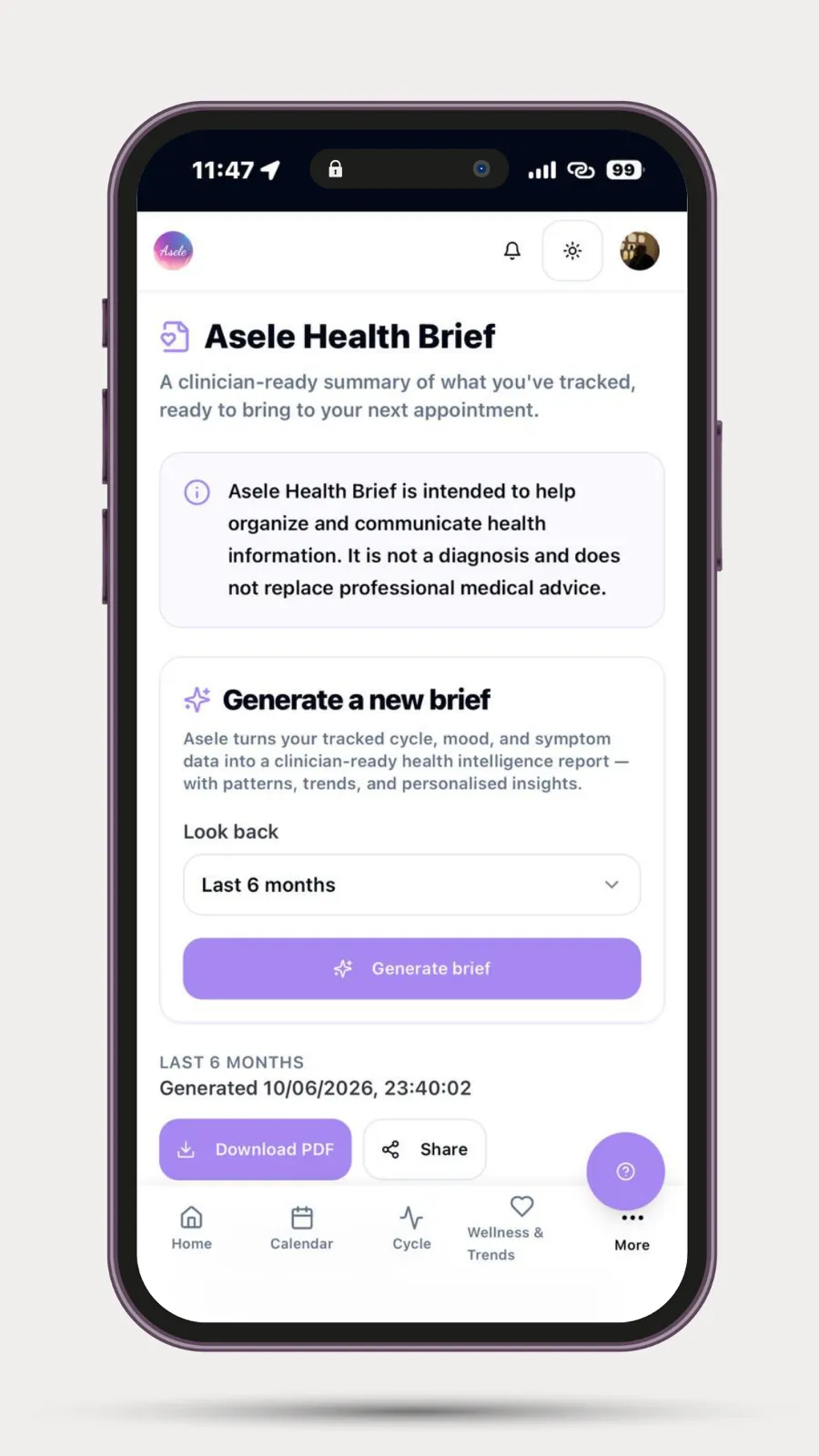
The Asele Health Brief is a clinician-ready summary of everything you've tracked: your cycle patterns, symptoms, mood trends, and journal notes, compiled into a structured report you can bring to your next appointment.
It's not a diagnosis. It's not medical advice. It's your health data, organised into the kind of clear, pattern-based summary that makes a real conversation with a clinician possible.
You choose the time window, the last 3 months, 6 months, or more, and Asele generates your brief automatically. You can download it as a PDF, share it directly, or simply pull it up on your phone or laptop in the waiting room.
What the Brief Actually Contains
The Health Brief is designed to be thorough without being overwhelming, for you and for your doctor. Here's what it includes:
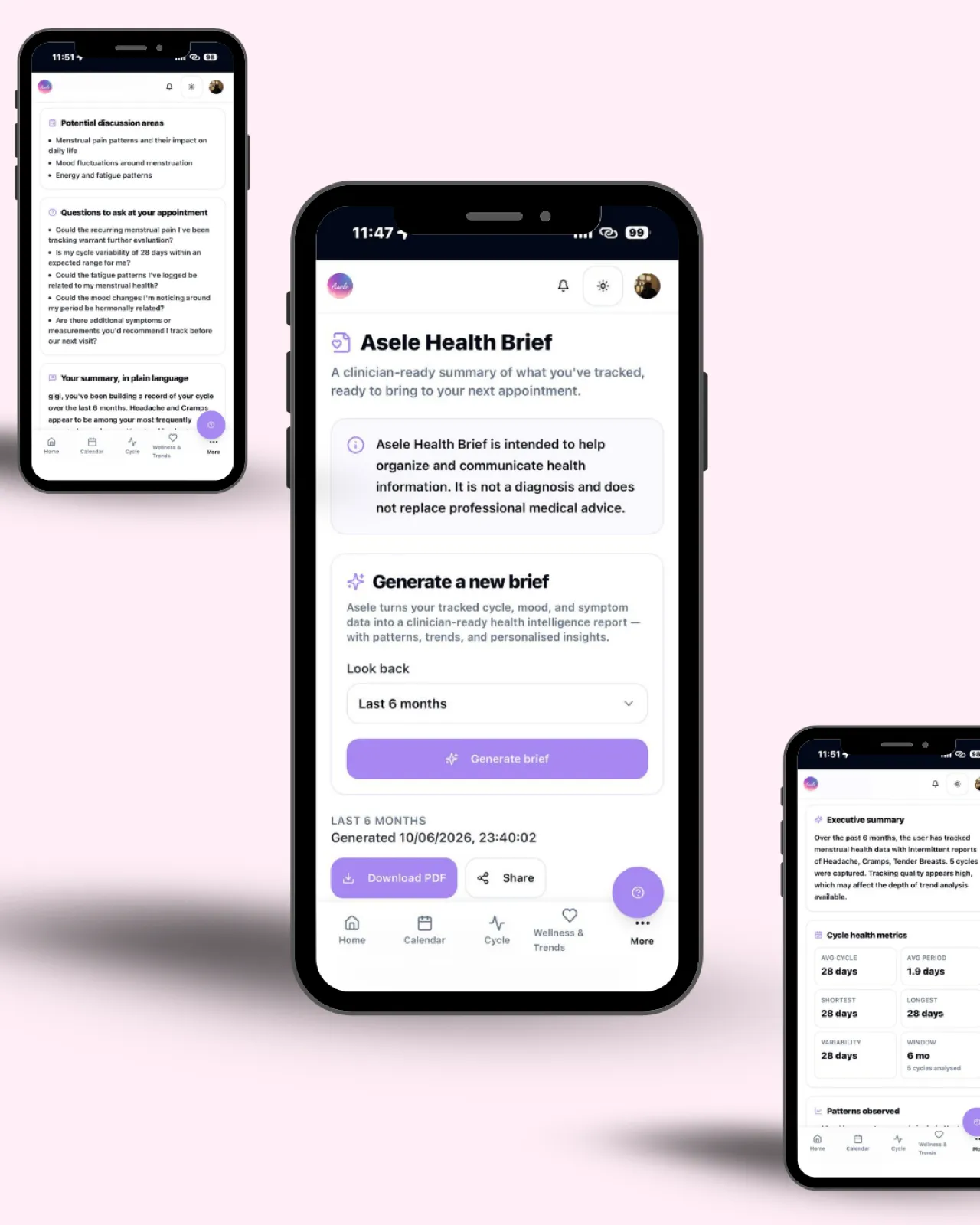
- Cycle Health Metrics give you a clear picture of your cycle at a glance: average cycle length, average period length, shortest and longest cycles, and overall variability. These numbers, tracked over time, are exactly the kind of objective data that can prompt a more productive clinical conversation.
- Patterns Observed surfaces the relationships between your symptoms and your cycle that are easy to miss in the day-to-day. For example, cramps and fatigue appearing together repeatedly, or mood shifts consistently showing up in the days before menstruation.
- Trends Across the Window shows how things have shifted over time, whether symptoms are increasing, whether mood logging has changed, what's consistent and what's new.
- Tracking Quality reflects how complete and consistent your data is, scored out of 100. A high tracking score means your brief can support stronger insight, and signals to a clinician that the data is reliable enough to take seriously.
- A Clinician-Ready Summary translates everything into clear, professional language, the kind of summary a GP or specialist might write themselves. This is the section you hand over.
- Questions to Ask at Your Appointment are generated directly from your data. Things like: "Could the recurring menstrual pain I've been tracking warrant further evaluation?" These aren't generic prompts; they come from what you've actually tracked.
- Triage Recommendations help you figure out what to do with what you're experiencing.
Knowing What to Do Next
One of the most common moments of uncertainty after noticing a pattern in your health is not knowing what level of attention it actually needs. Is this something to manage at home? Something to mention at your next routine appointment? Something to seek help for sooner?
The Health Brief includes a triage recommendations section that gives you pattern-based guidance on next steps for each symptom you've been logging. These are not diagnoses. They're a starting point.
For most commonly tracked symptoms, the guidance begins at Tier 1 self-care, recognising that many cycle-related experiences respond well to simple, consistent measures before escalating to clinical intervention. For fatigue, the brief suggests prioritising sleep, hydration, iron-rich meals, and gentle movement. For cramps, it recommends rest, gentle heat, hydration, and over-the-counter pain relief taken with food.
Each recommendation comes with a suggested question to carry into your next conversation with a clinician: "If this doesn't ease over the next 2 to 3 weeks, what should I try next?"
It's a small thing, but it matters. It gives you language. It gives you a next step.
Why This Matters
The women who use Asele aren't passive about their health. They're tracking. They're paying attention. They want to understand what's happening in their bodies, and they want their healthcare providers to understand it too.
The Health Brief is about making sure that effort counts. Months of consistent logging shouldn't live only in an app. It should be something you can walk into an appointment with and say: here's what I've been experiencing, here's the pattern, here's what I'd like to talk about.
That's what self-advocacy looks like in practice. And that's what we built the Health Brief to support.
Try It for Yourself
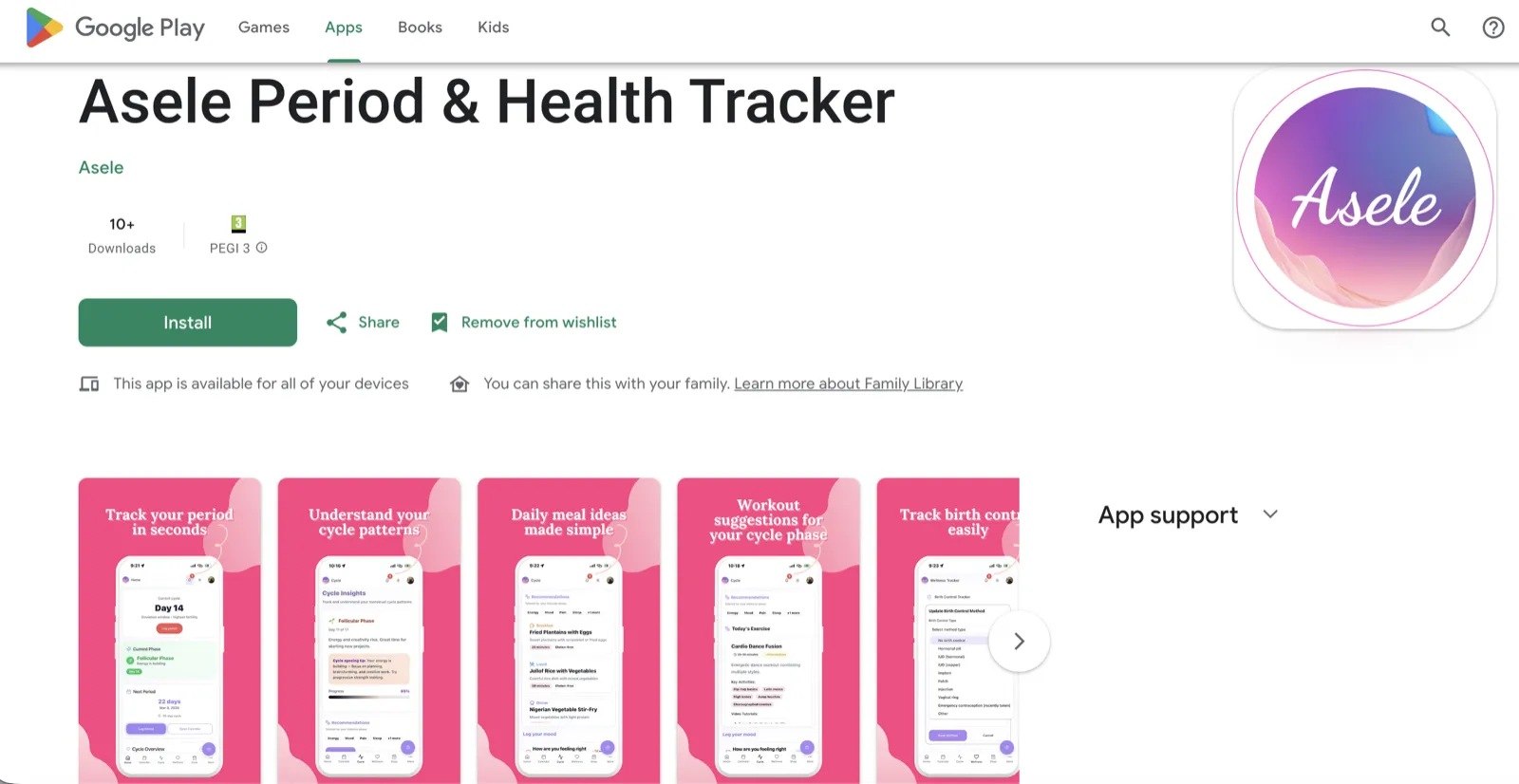
The Asele Health Brief is available to all Asele users. Start tracking your cycle, symptoms, and mood, and when you're ready, generate your brief before your next appointment. Asele is available on Android via the Google Play Store, and as a web app you can use on any device with no download required.
The Asele Health Brief is intended to help organise and communicate health information. It is not a diagnosis and does not replace professional medical advice.
← Back to The Journal