Cycle Syncing Your Workouts: What the Evidence Says
Cycle syncing says you should train hard in one phase and rest in another. The biggest reviews find that menstrual phase has a tiny, inconsistent effect on performance. Here is what the research shows, and where listening to your body still makes sense.
TL;DR: The largest meta-analysis on the topic found that exercise performance might dip very slightly in the first days of your period, but the effect was trivial and the studies were mostly low quality. There is no good evidence for strict phase-by-phase workout plans. What does matter is how you feel: fatigue, cramps, heavy days and low iron are worth adjusting for, and periods that stop because of training are a reason to see a doctor.
Scroll fitness content for long enough and you will meet the cycle syncing plan. Lift heavy and sprint in your follicular phase. Switch to yoga and walks in your luteal phase. Rest completely on your period. It sounds tidy and it feels kind, a training plan that finally treats your body as something other than a smaller man's. But does the research back it up? The short answer is: much less than the confident infographics suggest.
This post looks at the evidence itself. We wrote an earlier, lighter introduction in optimising your fitness routine around your cycle, and on the podcast Katherine Maree Pace shared her experience of endometriosis and cycle syncing as a way of living more gently with a painful condition. Here, we focus on what the studies on exercise performance found.
The idea behind cycle syncing
Across a typical cycle, oestrogen rises through the follicular phase and peaks just before ovulation, then progesterone climbs in the luteal phase while oestrogen settles at a moderate level. Your body temperature rises slightly after ovulation too.
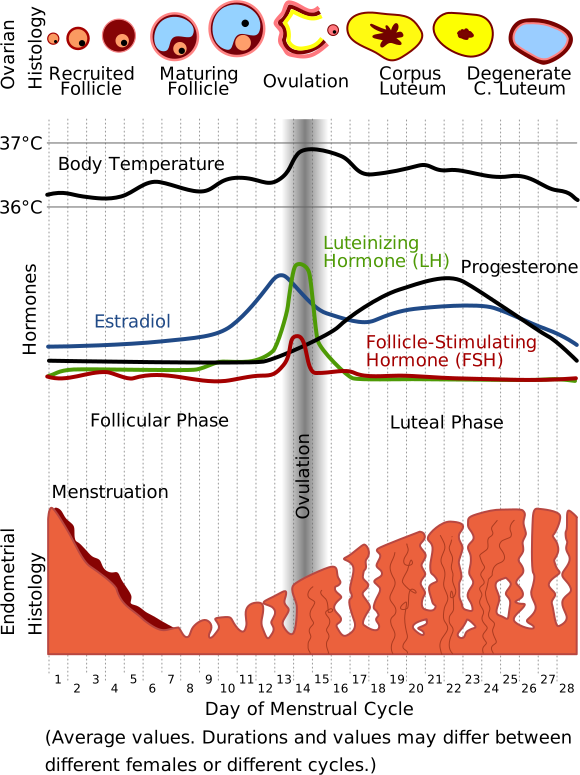
Oestrogen has effects on muscle and metabolism in lab studies, so the theory goes that you should be stronger and recover faster when it is high, and that the luteal phase, with higher progesterone and a warmer body, is better suited to gentler work. It is a reasonable hypothesis. The question is whether it shows up when women are tested in the lab.
Does your menstrual phase affect exercise performance?
Only slightly, and not consistently. In 2020, McNulty and colleagues published a systematic review and meta-analysis in Sports Medicine that pulled together 78 studies on women with regular, natural cycles. They found that performance in both strength and endurance tasks might be "trivially reduced" in the early follicular phase, roughly the days of your period, compared with every other phase. The average effect size was -0.06, so small that it sits close to zero, and the range of likely values crossed zero.
The authors also rated the overall quality of evidence as low. Because the effect was so small, the variation between studies so large and so many studies of poor quality, they concluded that general guidelines on exercise across the cycle cannot be formed. Their recommendation was a personalised approach based on how each woman responds.
What about strength training and building muscle?
The picture is similar. An umbrella review in Frontiers in Sports and Active Living in 2023 examined the published reviews on menstrual phase and resistance training. The findings were highly variable, and the authors noted a pattern of poor methods across the research. In their view, it is premature to conclude that hormone fluctuations meaningfully change strength, performance or muscle growth.
A tightly controlled 2025 study in The Journal of Physiology went further down to the muscle itself. Using biopsies and blood tests to confirm each phase, researchers found that muscle protein building after resistance exercise was the same in the late follicular and mid-luteal phases. The exercise made a difference. The phase did not. It was a small study of 12 women, but its methods were careful in exactly the ways earlier studies were not.
Why the effects are small and messy
Some of the inconsistency comes from how studies were run. Many estimated phases by counting days on a calendar instead of confirming them with blood tests or ovulation kits, so a woman labelled "luteal" may not have ovulated at all. As the charts in our post on why your cycle is a vital sign show, hormone levels and timing vary widely between cycles and between women.
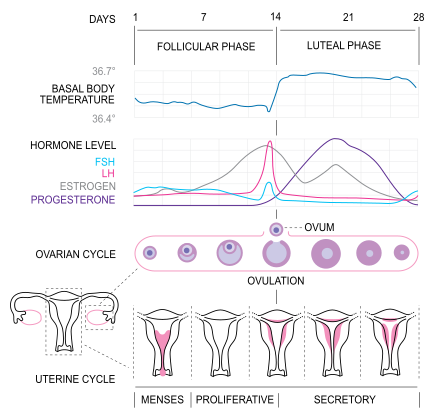
The neat 28-day model in diagrams like this one is an average. Your body may ovulate on day 12 one month and day 19 the next. A plan built on calendar days can easily put your "power phase" in the wrong week.
Where listening to your body still helps
None of this means your cycle is irrelevant to training. It means the hormones on their own are not the main story. Symptoms are.
In a survey of 6,812 exercising women recruited through the Strava app and published in the British Journal of Sports Medicine, the most common cycle symptoms were mood changes or anxiety (90.6%), tiredness (86.2%), stomach cramps (84.2%) and breast tenderness (83.1%). Women with more symptoms were more likely to miss or change training, skip competitions and take time off work.
So adjust for what you feel, not for what a calendar says your phase is:
- Cramps. Gentle movement helps some women; others need a rest day. Both are fine. For food that may ease pain, see nutrition and menstrual cramps.
- Heavy days. Choose kit and sessions you feel comfortable in, whether that is a period-proof pair of shorts for your Saturday run in Nairobi or swapping the treadmill for weights on day two.
- Pre-period slump. If the days before your period leave you flat and irritable, our guide to the luteal phase crash explains why and what helps.
- Fatigue that does not lift. Heavy periods drain iron, and iron carries oxygen to your muscles. If your runs feel harder and you are breathless on stairs, ask for a blood test, and read our guide to iron-rich foods for heavy periods, with West African options.
When should exercise and your period worry you?
See a doctor if your periods stop or become irregular after you increase training or cut back on food. The NHS lists doing too much exercise and sudden weight loss among the causes of missed periods, and a body that is not getting enough fuel can switch off ovulation. Also see a GP if period pain stops your usual activities, or if heavy bleeding leaves you tired and short of breath. Severe pain is never just something to train through.
So, should you cycle sync your workouts?
Use it as a loose guide, not a rulebook. If structuring your weeks around your cycle helps you show up consistently and feel more in tune with your body, that is a good outcome in its own right. But you do not need to skip heavy lifting in your luteal phase or sit out on your period if you feel strong. The fundamentals of consistency, progressive training, sleep and enough food matter far more than timing.
The most useful data is your own. Logging your workouts, energy and symptoms for a few cycles will show whether your body follows a pattern at all. Asele's cycle tracking and symptom logging can hold that record, and Amara can help you think through what you notice, in Yoruba, Hausa, Igbo, Swahili, French or English. If symptoms are getting in the way, the Asele Health Brief turns your logs into a short summary to take to your doctor. Find us at Asele.
This post is education, not medical advice. If your cycle changes or exercise feels harder than it should, speak to a doctor or nurse.
References
- McNulty KL, Elliott-Sale KJ, Dolan E, et al. The Effects of Menstrual Cycle Phase on Exercise Performance in Eumenorrheic Women: A Systematic Review and Meta-Analysis. Sports Medicine, 2020. pmc.ncbi.nlm.nih.gov
- Colenso-Semple LM, D'Souza AC, Elliott-Sale KJ, Phillips SM. Current evidence shows no influence of women's menstrual cycle phase on acute strength performance or adaptations to resistance exercise training. Frontiers in Sports and Active Living, 2023. pmc.ncbi.nlm.nih.gov
- Colenso-Semple LM, McKendry J, Lim C, et al. Menstrual cycle phase does not influence muscle protein synthesis or whole-body myofibrillar proteolysis in response to resistance exercise. The Journal of Physiology, 2025. pmc.ncbi.nlm.nih.gov
- Bruinvels G, Goldsmith E, Blagrove R, et al. Prevalence and frequency of menstrual cycle symptoms are associated with availability to train and compete: a study of 6812 exercising women recruited using the Strava exercise app. British Journal of Sports Medicine, 2021. doi.org
- NHS. Stopped or missed periods. nhs.uk
- NHS. Period pain. nhs.uk
Image credits
- Menstrual cycle hormones diagram: Speck-Made, CC BY-SA 3.0, via Wikimedia Commons (MenstrualCycle).
- 28-day cycle diagram: Isometrik, CC BY-SA 3.0, via Wikimedia Commons (MenstrualCycle2).
← Back to The Journal