Your Cycle Is a Vital Sign: What Your Period Says About Your Health
Doctors check your pulse, temperature and blood pressure. The American College of Obstetricians and Gynecologists says your menstrual cycle belongs on that list too. Here is what cycle length, flow and pain can tell you, and when to get checked.

TL;DR: The American College of Obstetricians and Gynecologists (ACOG) calls the menstrual cycle a vital sign, because changes in it can point to thyroid problems, PCOS, bleeding disorders, stress or not eating enough. For most adults, periods come every 21 to 35 days and last 2 to 7 days. See a doctor if your periods stop for three months, come closer than 21 days apart, last longer than 7 days, soak a pad every hour or two, or bring pain that stops your day.
When you sit down at a clinic, someone usually checks your pulse, your temperature and your blood pressure before the doctor even says hello. Those numbers are vital signs: quick, everyday readings that tell a clinician whether something deeper needs a look. Your period works the same way. How often it comes, how long it lasts, how heavy it is and how much it hurts are all readings your body takes every month. Most of us were taught to treat them as a private inconvenience to manage quietly. The better way to see them is as information.
What does it mean that your cycle is a vital sign?
It means your period pattern is a health signal, as worth tracking as your blood pressure. In a 2015 committee opinion, reaffirmed in 2025, ACOG recommended that clinicians treat the menstrual cycle as an additional vital sign for girls and teenagers, and ask at every check-up about the first day of the last period and the usual pattern. Their reasoning was simple: spotting an unusual pattern early may catch health problems that would otherwise surface years later.
The guidance was written for adolescents, but the idea holds for anyone who menstruates. A cycle that suddenly changes is your body flagging that something in the system has shifted.
What a typical cycle looks like
Your cycle is a relay between your brain and your ovaries. Hormones from the pituitary gland, called FSH and LH, prompt an egg to mature and then release. Oestrogen builds up the lining of your womb in the first half of the cycle, progesterone takes over after ovulation, and when no pregnancy happens, both fall and the lining sheds as your period.
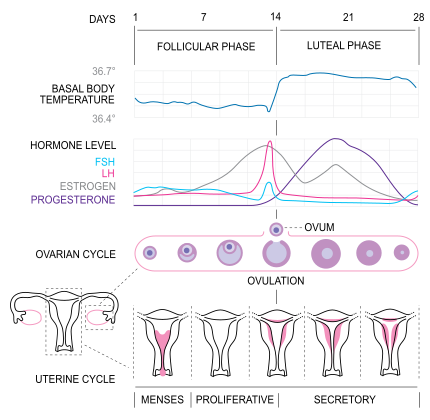
The textbook cycle is 28 days, but very few bodies read the textbook. The NHS says periods typically come every 21 to 35 days and last 2 to 7 days, usually around 5, with the heaviest bleeding in the first 2 days. Over a whole period you lose roughly 20 to 90ml of blood, about 1 to 5 tablespoons.
For teenagers the range is wider. ACOG notes that cycles in the first years after a first period typically run 21 to 45 days, with bleeding of 7 days or less and three to six pads or tampons a day. If you have a daughter who has just started, our guide to what to expect before her first period covers the early years.
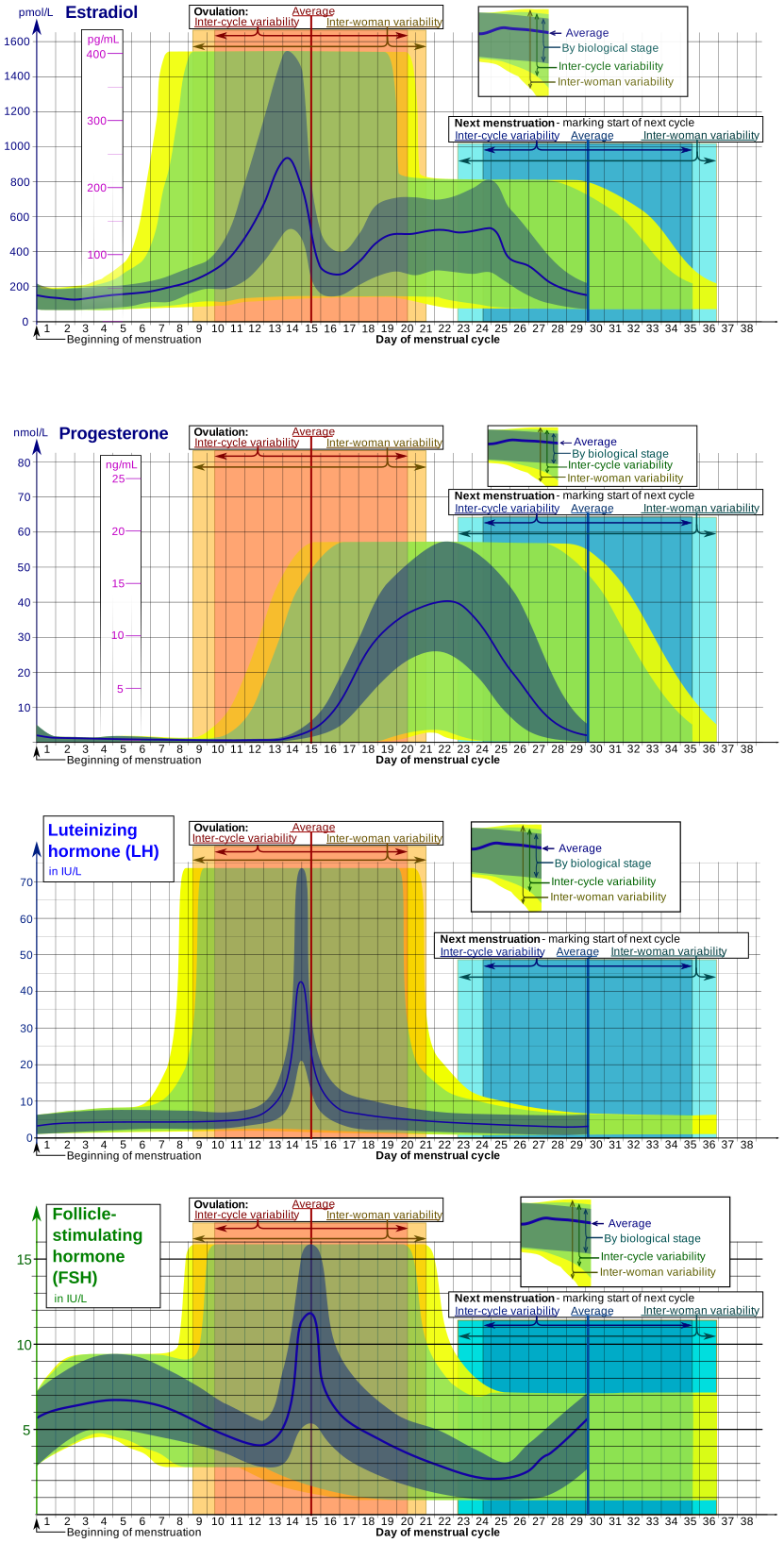
Hormone levels also vary a lot from cycle to cycle and from woman to woman. The charts below show just how wide the normal band is, which is why your own pattern over several months tells you more than any single "perfect" number.
What your cycle can be telling you
Each part of your period carries its own clues. None of these are a diagnosis on their own, but they are worth noticing.
Cycle length and regularity. The NHS describes periods as irregular when the gap between them is less than 21 days or more than 35 days, or when your usual pattern changes. Common causes include puberty, perimenopause, pregnancy, hormonal contraception, stress, big changes in weight and heavy exercise. Long or unpredictable cycles are also one of the main signs of PCOS, which a global consensus has now renamed polyendocrine metabolic ovarian syndrome (PMOS). We explain the condition in PCOS explained.
Periods that stop. Pregnancy is the first thing to rule out. After that, the NHS lists stress, sudden weight loss, too much exercise and both an overactive or underactive thyroid among the causes. Your thyroid sets the pace for much of your metabolism, and it can make periods heavier, lighter or absent; we go deeper in how your thyroid affects your period.
Under-eating and over-training. When your body is not getting enough fuel for what you ask of it, it can switch off ovulation to save energy. This can happen with restrictive dieting, eating disorders, or heavy training without enough food. ACOG lists eating disorders and mental stress alongside PCOS and thyroid disease as causes of disrupted cycles. A missing period here is a message, not a badge of discipline.
Heavy flow. The NHS says you may have heavy periods if you change your pad or tampon every 1 to 2 hours, need to double up on products, bleed for more than 7 days, pass clots larger than about 2.5cm, or bleed through to your clothes or bedding. Causes include fibroids, endometriosis, adenomyosis and PCOS. Heavy bleeding can also be the first sign of a bleeding disorder such as von Willebrand disease, especially if you bruise easily or bleeding problems run in your family. The NHS notes fibroids are more likely in women from a Black background or with a close relative who has them, so mention any family history. Read more in heavy periods: causes and solutions.
Tiredness that follows your flow. Month after month of heavy bleeding can drain your iron. If you feel tired, breathless or foggy, especially around your period, iron deficiency anaemia is worth checking with a simple blood test.
Pain. Some cramping is common. Pain that stops you going to work or school, or that gets steadily worse, is not something to push through. The NHS advises seeing a GP if period pain stops your usual daily activities, or if you have pain during sex, when peeing or pooing, or bleeding between periods.
When should you see a doctor about your period?
See a doctor or nurse if your periods change from your usual pattern or match any of the signs below. Book an appointment if:
- your periods have not started by age 15
- you have missed three periods in a row and are not pregnant
- your cycles are shorter than 21 days or longer than 35 (or 45 for teenagers)
- bleeding lasts more than 7 days
- you soak through a pad or tampon every 1 to 2 hours, or pass large clots
- pain stops you doing your usual activities
- you bleed between periods or after sex
- you also notice hair growth on your face, acne, weight changes or constant tiredness
Get urgent help if you are bleeding so heavily you feel dizzy or faint, or if you have sudden severe pain in your lower tummy, particularly if you could be pregnant.
These thresholds come from ACOG and the NHS. For more on irregular cycles specifically, see irregular periods: when to see a doctor.
Why does tracking your cycle help at the doctor's?
Because a written record turns "my periods are a bit off" into clear evidence a clinician can act on. Many women across Lagos, Nairobi, Accra and London describe the same experience: walking into a short appointment, being asked "when was your last period?", and not quite remembering. Or mentioning heavy bleeding and being told it is normal, with nothing to show otherwise.
Tracking changes that. Note the first day of each period, how many days you bleed, how many pads or tampons you use on your heaviest day, and how bad the pain is on a simple 1 to 10 scale. After three months you have a pattern. If you are not sure where to start, try one of these three easy ways to track your period.
This is where Asele can quietly help. Cycle tracking and symptom logging build that record for you, and Amara can talk through what you are noticing in Yoruba, Hausa, Igbo, Swahili, French or English. Before an appointment, the Asele Health Brief pulls your logs into a short summary you can take to your doctor. You can find us at Asele.
Your period is not just something to get through each month. It is one of the clearest windows you have into how your whole body is doing, and it deserves the same attention as your pulse.
This post is education, not medical advice. If something about your cycle worries you, speak to a doctor, nurse or pharmacist who can examine you.
References
- American College of Obstetricians and Gynecologists. Committee Opinion No. 651: Menstruation in Girls and Adolescents: Using the Menstrual Cycle as a Vital Sign. Obstet Gynecol 2015;126:e143-6. Reaffirmed 2025. acog.org
- NHS. Periods. nhs.uk
- NHS. Irregular periods. nhs.uk
- NHS. Stopped or missed periods. nhs.uk
- NHS. Heavy periods. nhs.uk
- NHS. Period pain. nhs.uk
- NHS. Fibroids. nhs.uk
Image credits
- Menstrual cycle diagram: Isometrik, CC BY-SA 3.0, via Wikimedia Commons (MenstrualCycle2).
- Hormone variability charts: Mikael Häggström, public domain, via Wikimedia Commons (hormone charts).
← Back to The Journal