Women's Health at Work: A Guide for Employers
A practical guide for HR leads, people managers and founders on supporting women's health at work, from periods and menopause to pregnancy, loss, mental health and privacy, with the laws that apply in the UK, Kenya, South Africa, Zambia and beyond.

TL;DR: Women's health shapes how people feel and perform at work every single month, and most of it happens in silence. Menstrual symptoms alone cost women around nine days of lost productivity a year, mostly while they are still at their desks. Menopause pushes experienced women out of jobs they would rather keep. The fixes are mostly simple and cheap: a clear policy, trained line managers, decent facilities, flexibility, and health support that employees can use privately. Keep health data out of your hands, measure in aggregate, and review every year.
If you lead a team, women's health is already part of your working day, whether or not anyone talks about it. It is the colleague who works through cramps with a hot water bottle under her desk, the manager in her late 40s who has not slept properly in months, the new mother pumping milk in a toilet cubicle, the analyst who quietly booked "a dentist appointment" for her embryo transfer. Across Lagos, Nairobi, Accra, Johannesburg, London and every distributed team in between, women are managing their health around their jobs and saying very little.
This guide is for the people who can change that: HR leads, people managers and founders. It sets out the business case, the practical basics, the laws that apply in the countries our community lives and works in, and a step-by-step plan you can start this quarter. Each section links to deeper reading on our journal if you want to understand the health side in more detail.
Why does women's health matter to employers?
Because it affects attendance, performance, retention and legal risk, and because most of the cost is invisible. A study of 32,748 women in the Netherlands, published in BMJ Open, found that women lost a mean of 1.3 days a year to period-related absence and 8.9 days a year to reduced productivity while at work. Presenteeism, working while unwell, was a far bigger cost than sick days. When women did call in sick because of their periods, only one in five told their employer the reason. Two thirds of the women in the study said they wished they had more flexibility in their tasks and hours during their periods.
Menopause tells a similar story later in working life. The CIPD's 2023 survey of over 2,000 employed women aged 40 to 60 found that two thirds of those with menopause symptoms said they had a mostly negative effect on them at work, and over half could think of a time they were unable to go into work because of their symptoms. Around one in six had considered leaving because of a lack of support, and a further 6% had already left. Women from ethnic minority backgrounds were more likely than white women to say their symptoms had hurt their career progression, at 38% compared with 25%.
The UK House of Commons Women and Equalities Committee put it plainly in its 2022 inquiry report: menopause is a workplace issue, with a legal, economic and social imperative to act. Its own survey found that fewer than a third of women experiencing menopause told anyone at work, and only 12% asked for any adjustments, often because they worried about the reaction. The Committee warned that employers who fail to support these employees risk discrimination claims, their reputation and their ability to keep experienced women.
For African women the picture carries extra weight. The ILO reports that women perform 76.2 per cent of all unpaid care work worldwide, and that in Africa the most common unpaid carer is a woman of working age. A 2026 qualitative study in BJOG found that among women in Ghana, menopause intensified occupational and economic strain, disrupted income and caregiving, and was often hidden because of stigma; the authors called for stronger workplace protections. When health, caring duties and work all land on the same person, small supports at work make a big difference.
What do women need for menstrual health at work?
The basics first. The World Health Organization calls for menstruation to be treated as a health issue, not a hygiene issue, and says menstrual health means having the products people need, water, sanitation and disposal facilities, and an environment where they can work without shame, so they can fully participate in work. UNICEF estimates that 1.8 billion people menstruate every month, and that millions cannot manage their periods with dignity.
In practice, that means:
- Clean, private, lockable toilets with running water, soap and a covered bin in every cubicle, including on sites, in warehouses and at field locations.
- Free pads in the toilets, ideally alongside tampons or other options, so nobody has to leave a shift or a meeting because they were caught out.
- Toilet breaks when people need them, not only at scheduled times, which matters most on production lines, in retail and in customer-facing roles.
- Flexibility on bad days, such as starting later, working from home where the role allows, or swapping a physically demanding task.
- Sick leave that does not punish monthly patterns. Absence policies that trigger warnings after a set number of short absences can catch women with endometriosis or heavy periods unfairly.
Painful or heavy periods can signal conditions like endometriosis or heavy menstrual bleeding, which deserve medical care and a manager who takes them seriously. Our podcast episode on cycles as a workplace strength looks at how teams can talk about this openly.
Is menstrual leave a legal right anywhere?
In some places, yes. In Zambia, the Employment Code Act 2019 gives every female employee the right to one day's absence from work each month without a medical certificate or giving a reason, known as Mother's Day. In Spain, Organic Law 1/2023 created a special category of temporary incapacity for disabling secondary menstruation, meaning severe period pain linked to conditions such as endometriosis, fibroids or adenomyosis. Laws in this area change, so check the current position before you write a policy. Where there is no legal right, you can still choose to offer flexible or paid time off for severe symptoms.
How should employers support menopause at work?
Start by knowing the law, then make practical changes. In the UK, the Equality and Human Rights Commission published guidance for employers on menopause in February 2024. It explains that if menopause symptoms have a long-term and substantial effect on a woman's ability to carry out normal day-to-day activities, they could count as a disability. In that case the employer must make reasonable adjustments and must not discriminate. Women with menopause symptoms may also be protected from discrimination and harassment because of age and sex.
Acas adds that menopause is not a protected characteristic on its own, but that treating someone less favourably because of their symptoms could be age, disability or sex discrimination, and that jokes or unwanted comments about symptoms could count as harassment. It advises employers to focus on supporting the person rather than trying to decide whether their condition is a disability. Under the Employment Rights Act 2025, menopause action plans are voluntary now and will become mandatory for employers with 250 or more workers, expected from 2027.
Acas also sets out what a menopause risk assessment should look at: temperature and ventilation, the fit and fabric of uniforms, somewhere to rest, easy access to toilets and cold drinking water, and whether managers have been trained. It recommends recording menopause-related absence separately from other sickness, because counting it in a general attendance record could be unfair or discriminatory. We cover the symptoms behind these adjustments in our menopause guide, including hot flushes and brain fog.
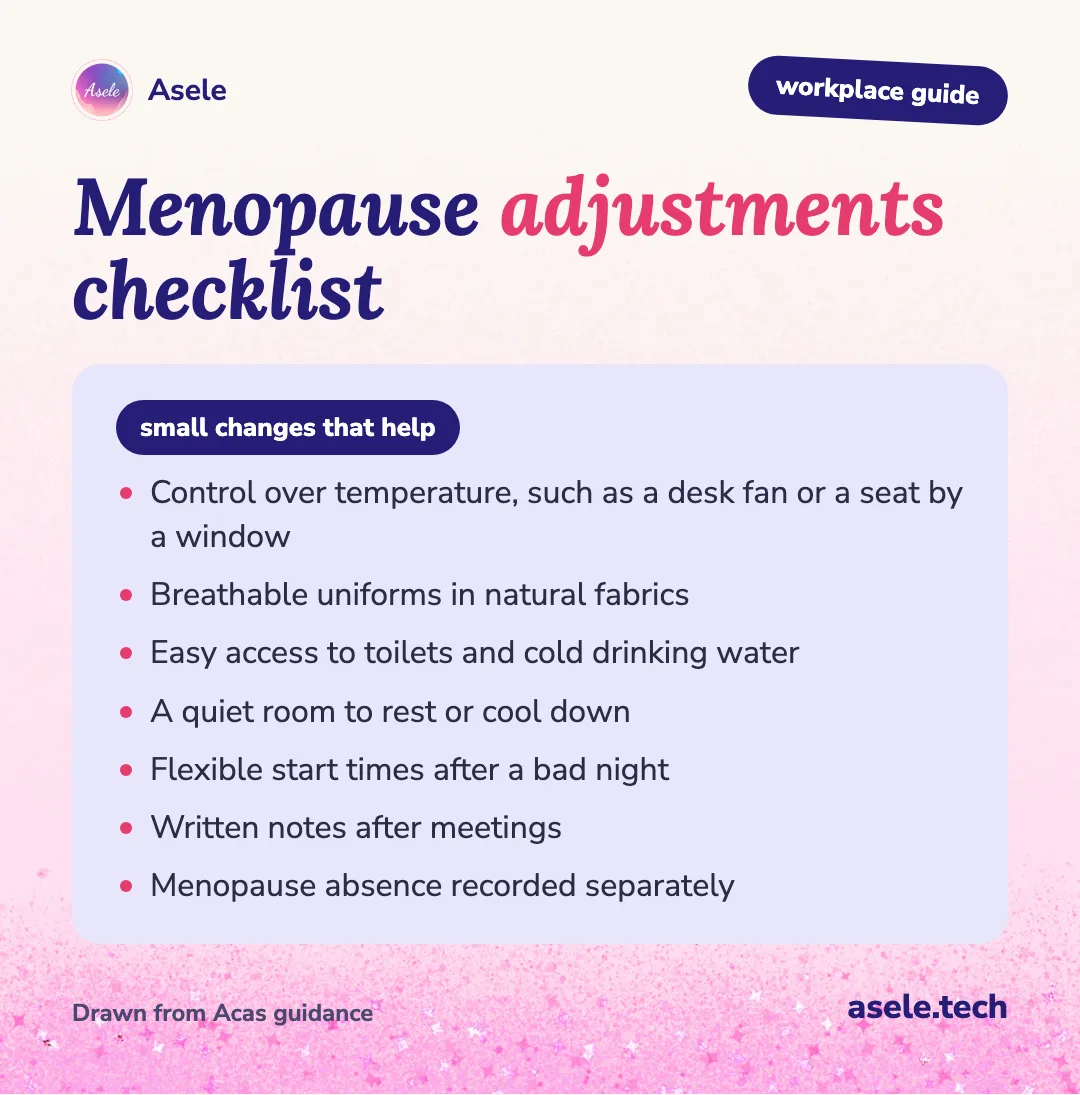
Practical adjustments drawn from Acas guidance. Most cost little or nothing.
What are the rules on pregnancy, maternity and returning to work?
The global baseline is the ILO's Maternity Protection Convention, 2000 (No. 183). It sets maternity leave of not less than 14 weeks, including six weeks of compulsory leave after birth, with cash benefits of at least two thirds of previous earnings. It makes it unlawful to dismiss a woman because of pregnancy, leave or nursing, and gives women the right to daily breaks or reduced hours to breastfeed. National laws vary a lot, and many go further.
| Country | Statutory maternity leave | Pay and good to know |
|---|---|---|
| ILO standard (C183) | At least 14 weeks | At least two thirds of previous earnings; daily breastfeeding breaks |
| Kenya | Three months | Full pay, with the right to return to the same or a suitable job (Employment Act 2007) |
| South Africa | At least four consecutive months | Paid through the Unemployment Insurance Fund, not by the employer by law (Basic Conditions of Employment Act) |
| Zambia | 14 weeks | Full pay after 24 months with the same employer; daily nursing breaks for six months (Employment Code Act 2019) |
| United Kingdom | 52 weeks | Statutory Maternity Pay for up to 39 weeks; at least 2 weeks must be taken after birth |
Statutory minimums from official sources. Laws and rates change, so check the current law or take legal advice before writing policy.
In Kenya, the Employment Act gives three months of maternity leave with full pay and the right to return to the same job or a suitable one. Kenya's Health Act 2017 goes further on breastfeeding: all employers must set up lactation stations with handwashing facilities, a fridge or cooling, electrical outlets for breast pumps and comfortable seating, and the station must not be in a toilet. Nursing employees must get paid break intervals to breastfeed or express, of up to one hour in every eight-hour working day.
In South Africa, the Basic Conditions of Employment Act gives at least four consecutive months of maternity leave, with benefits paid under the unemployment insurance system, and no employee may work for six weeks after birth unless a doctor or midwife certifies she is fit. In Zambia, the Employment Code Act 2019 gives 14 weeks of maternity leave, with full pay after 24 months' service, and nursing mothers are entitled to two 30-minute breaks or one hour-long break each working day. In the UK, statutory maternity leave is 52 weeks, with Statutory Maternity Pay for up to 39 weeks, and employees can take paid time off for antenatal appointments.
Whatever the law where you operate, a good return to work looks the same: a phased return if possible, a clean private room to express milk (never a toilet), a fridge, protected time to pump, and a manager who checks in without assuming. Our pregnancy guide and post on breastfeeding and common challenges explain what new mothers are managing.
How can employers support pregnancy loss and fertility treatment?
With kindness, flexibility and clear rules. Acas guidance in the UK says that if a baby is stillborn after 24 weeks, the birth mother is still entitled to up to 52 weeks of statutory maternity leave, and parents may be entitled to two weeks of parental bereavement leave. For a miscarriage before 24 weeks there is currently no statutory leave, but Acas says employers should still consider offering time off, record any pregnancy-related sickness separately, and never count it towards absence trigger points. The Employment Rights Act 2025 will introduce a new right to unpaid bereavement leave that includes pregnancy loss, of at least one week, expected in 2027.
Elsewhere, South Africa's Basic Conditions of Employment Act gives six weeks of maternity leave after a miscarriage in the third trimester or a stillbirth. Spain's 2023 law also recognises temporary incapacity after a pregnancy ends, whether voluntarily or not.
Fertility treatment needs a similar approach. Acas says there is no legal right to paid time off for IVF appointments in the UK, but employers should treat them like any other medical appointment. Once a worker reaches embryo transfer, she has the same protection from discrimination as a pregnant worker, and if the transfer is unsuccessful she stays protected for two weeks after finding out. A full IVF cycle takes around three to six weeks, and many people need more than one. Our posts on miscarriage and IVF explain what employees go through physically and emotionally.
What about mental health, burnout and domestic abuse?
The WHO estimates that 12 billion working days are lost every year to depression and anxiety, at a cost of US$1 trillion in lost productivity. It recommends organisational changes to reduce job stressors, manager training so supervisors can recognise and respond to people who are struggling, and mental health awareness training for all workers. Hormonal shifts across the cycle, after birth and around menopause can affect mood, so mental health support belongs in any women's health plan. Our mental health guide and post on burnout or depression can help managers understand the difference. Our podcast episode Leading While Bleeding explores burnout and health in leadership.
Domestic abuse is a workplace issue too. The ILO's Violence and Harassment Convention, 2019 (No. 190) notes that domestic violence can affect employment, productivity and health and safety, and that employers can help recognise and respond to it. In the UK, Acas says employers have a duty of care and should look out for signs, respond appropriately and support employees experiencing abuse. Practical help includes safe ways to communicate if a phone or email is being monitored, a code word, flexible hours, time off for support appointments and a written domestic abuse policy. The UK government's domestic abuse guidance and its review of workplace support for victims are good starting points. Our post on abuse and women's health covers the health effects.
How should employers handle health data in workplace programmes?
Carefully, and as little of it as possible. In the UK, the Information Commissioner's Office says that information about a worker's physical or mental health is special category data, which needs a lawful basis and an additional special category condition before you can process it. You must be clear about why you are collecting it and use it only in ways workers would reasonably expect. The ICO also warns that employers will find it hard to rely on consent, because workers may feel they cannot say no; consent only works if someone can refuse without fear of penalty and withdraw at any time.
The same principle runs through African data law. Nigeria's Data Protection Act 2023 lists health status as sensitive personal data and restricts processing it to specific grounds, such as consent for a specific purpose or obligations under employment law. Kenya's Data Protection Act 2019 also treats health status as sensitive personal data and defines health data broadly, covering past, present and future physical or mental health.
The practical lesson for any women's health programme is simple: design it so that you never hold the sensitive data in the first place. Employees should use health tools on their own terms, and you should see only anonymised, aggregate numbers.
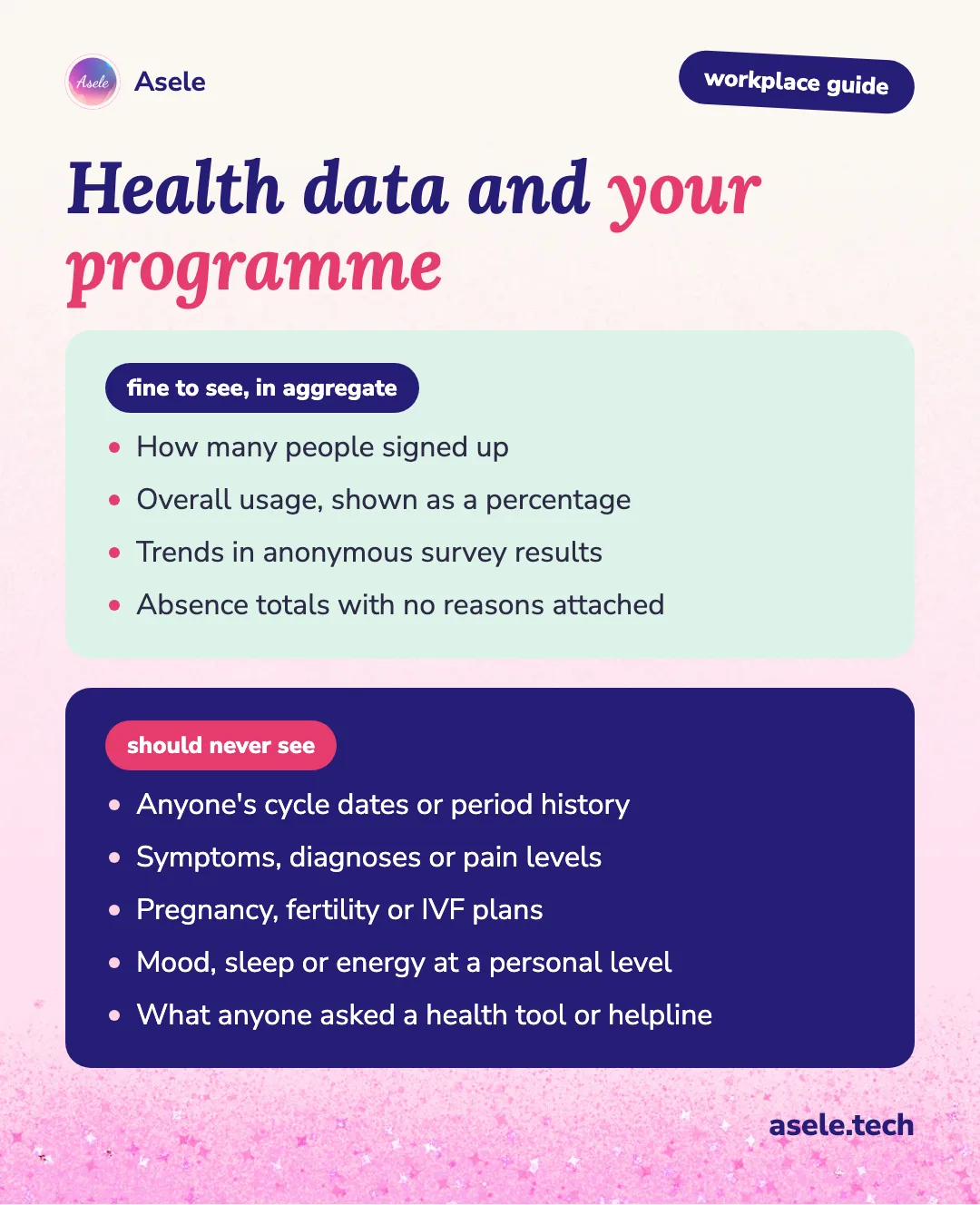
If a programme would show you any of the items in the second panel, ask why before you sign.
This is how Asele for Business works. Employees sign up with their own personal email and get private cycle and symptom tracking, health preparation tools and our AI health guide. Employers see activation counts and aggregate usage percentages, plus their own billing records. They never see cycle dates, symptoms, mood data, conversations or anything that identifies a person, and when someone leaves, their health history stays with them.
How do I start? A step-by-step plan
You do not need a big budget to begin. The Women and Equalities Committee heard that supporting menopausal employees need not be costly or resource intensive, and the same is true across women's health. Here is a plan you can start this quarter.
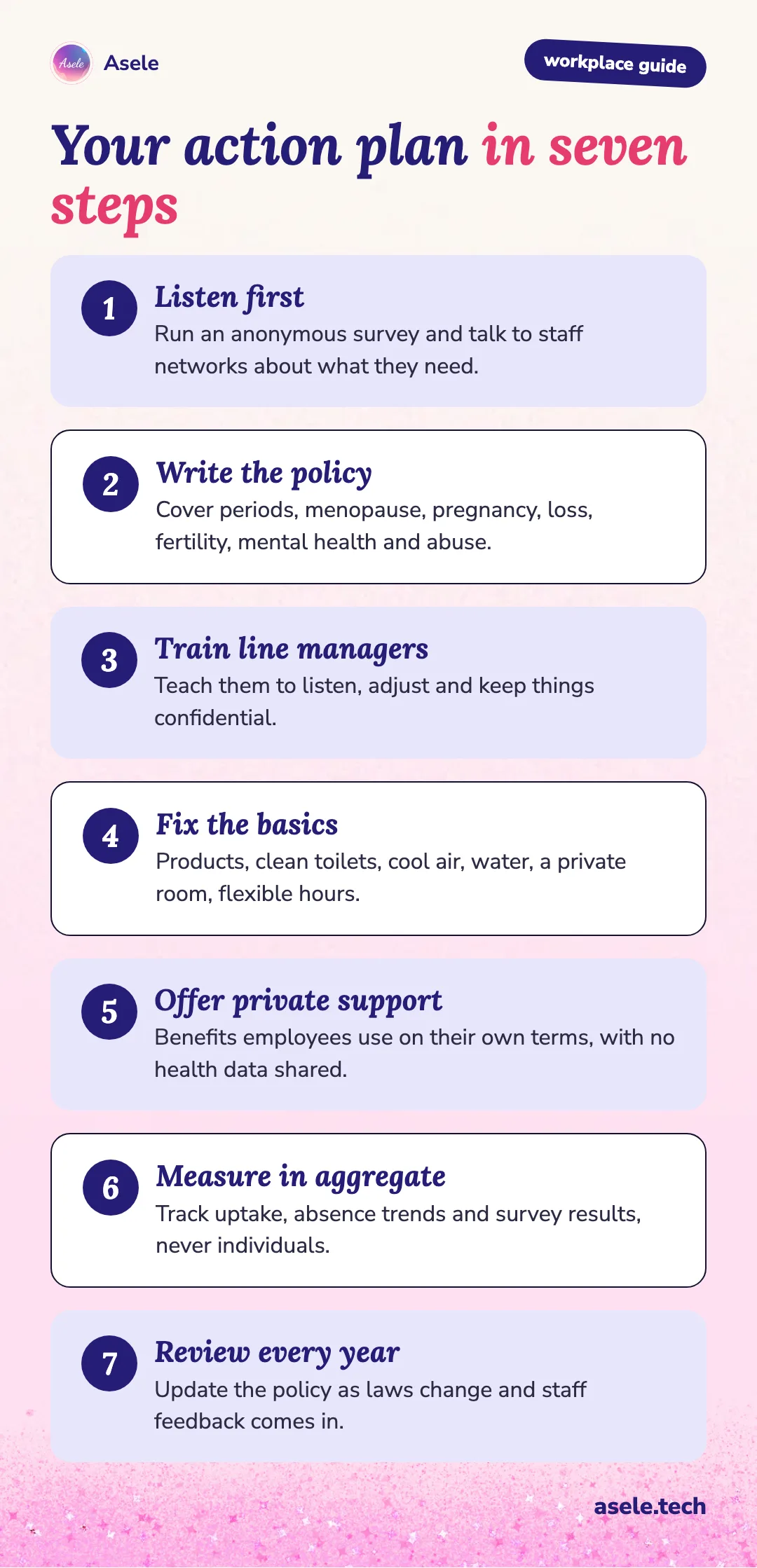
Seven steps, in order. Steps 1 to 4 cost very little.
1. Listen first. Run a short anonymous survey and talk to any women's or parents' networks. Ask what gets in the way and what would help. Include people on shifts, in the field and working remotely, not only head office.
2. Write the policy. One clear women's health policy, or a set of linked policies, covering the areas below. Acas recommends that a menopause policy explains what support is available, who the point of contact is and what training managers get, and that you check your absence, flexible working and health and safety policies for links.
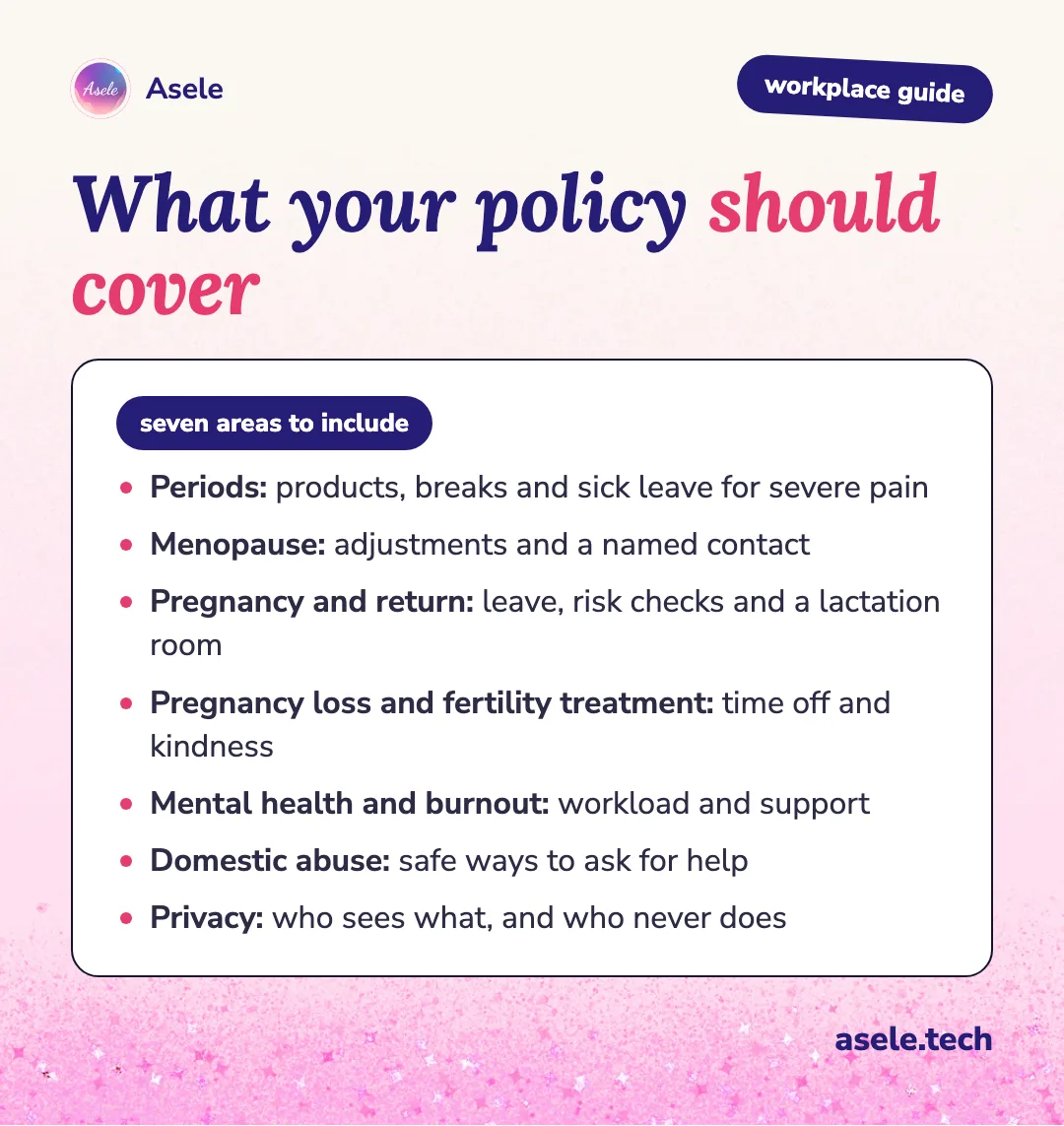
A good policy covers the whole of working life, not one stage of it.
3. Train line managers. The Women and Equalities Committee heard that the attitude of line managers can decide whether women going through menopause feel able to ask for support, or even stay in their job. Acas advises training all managers, supervisors and team leaders on how the law relates to menopause, how to talk sensitively, what support is available and how to handle issues fairly. The WHO makes the same recommendation for mental health. A 45-minute session and a one-page guide go a long way.
4. Fix the basics. Free products in the toilets, bins in every cubicle, working fans and ventilation, cold water, a quiet room that doubles as a lactation room, and flexibility in how and when work gets done.
5. Offer private support. Choose benefits that employees can use without telling you anything. Check every provider's data model against the privacy panel above, and ask for a data processing agreement.
6. Measure in aggregate. Track uptake, overall absence trends, retention and survey results year on year. Never ask managers to track individual cycles or symptoms.
7. Review every year. Laws are moving quickly in this area, from UK menopause action plans to new leave rights. Revisit your policy annually, and when your staff tell you something is not working.
If you would like help with steps 5 and 6, Asele for Business offers early partners a free pilot.
Frequently asked questions
Do we need a separate menopause policy?
Not by law in most places, but it helps. Acas says a specific menopause policy can help everyone understand what menopause is, how it affects people differently and what support is available. Many employers fold it into a wider women's health policy that also covers periods, pregnancy and loss, which avoids gaps between life stages.
Should we offer menstrual leave?
It is a legal right in some places, such as Zambia's monthly Mother's Day, and Spain recognises severe period pain linked to conditions like endometriosis as temporary incapacity. Elsewhere it is your choice. Flexible working, a relaxed approach to short absences and recording period-related sickness fairly often meet the same need. Ask your employees what would help most.
Can we ask employees about their health to plan support?
You can ask anonymously and in aggregate, for example through a survey that does not collect names. Collecting identifiable health information is different: the UK ICO treats it as special category data, and Nigeria's and Kenya's data protection laws treat health status as sensitive personal data. Only collect it when you have a clear purpose and lawful basis, such as making a reasonable adjustment someone has asked for.
Is this only relevant to large companies?
No. Small teams feel the loss of one experienced person more sharply than large ones. Most of the steps in this guide, such as products in the toilets, a trained manager, flexible hours and a clear policy, cost very little. Legal duties like maternity leave, lactation breaks and data protection apply regardless of company size in the countries covered here.
How do we support remote and distributed teams across countries?
Write one policy that meets the highest standard you can offer everywhere, then check it against local law in each country where you employ people. Remote staff still need flexibility, a manager who checks in and access to private health support. Their home set-up is not a reason to leave them out.
This guide is general information, not legal or medical advice. Employment and data protection laws change, so check the current law where you operate or speak to an employment lawyer before you finalise a policy.
References
- Schoep ME, et al. Productivity loss due to menstruation-related symptoms: a nationwide cross-sectional survey among 32 748 women. BMJ Open, 2019. pubmed.ncbi.nlm.nih.gov
- CIPD. Menopause in the workplace: employee experiences in 2023. cipd.org
- House of Commons Women and Equalities Committee. Menopause and the workplace, First Report of Session 2022 to 23, July 2022. parliament.uk
- International Labour Organization. ILO calls for urgent action to prevent looming global care crisis. ilo.org
- Tweneboah-Koduah F, et al. Menopause as an embodied and occupational disruption: a qualitative study of women's experiences in Ghana. BJOG, 2026. pubmed.ncbi.nlm.nih.gov
- World Health Organization. WHO statement on menstrual health and rights, June 2022. who.int
- UNICEF. Menstrual hygiene. unicef.org
- Republic of Zambia. Employment Code Act No. 3 of 2019. parliament.gov.zm
- Spain. Ley Orgánica 1/2023, de 28 de febrero. Boletín Oficial del Estado. boe.es
- Equality and Human Rights Commission. Menopause in the workplace: guidance for employers, 2024. equalityhumanrights.com
- Acas. Menopause and the law. acas.org.uk
- Acas. Supporting staff through the menopause. acas.org.uk
- International Labour Organization. Maternity Protection Convention, 2000 (No. 183). normlex.ilo.org
- Republic of Kenya. Employment Act, 2007. Kenya Law. kenyalaw.org
- Republic of Kenya. Health Act, 2017. Kenya Law. kenyalaw.org
- Republic of South Africa. Basic Conditions of Employment Act 75 of 1997. gov.za
- GOV.UK. Maternity pay and leave: leave. gov.uk
- GOV.UK. Maternity pay and leave: pay. gov.uk
- Acas. Antenatal appointments. acas.org.uk
- Acas. Time off for stillbirth or miscarriage. acas.org.uk
- Department for Business and Trade. Employment Rights Act factsheet: bereavement, paternity and unpaid parental leave. gov.uk
- Acas. IVF treatment. acas.org.uk
- World Health Organization. Mental health at work fact sheet. who.int
- International Labour Organization. Violence and Harassment Convention, 2019 (No. 190). normlex.ilo.org
- Acas. Domestic violence and abuse. acas.org.uk
- GOV.UK. Domestic abuse: how to get help. gov.uk
- GOV.UK. Workplace support for victims of domestic abuse: review report, 2021. gov.uk
- Information Commissioner's Office. Data protection and workers' health information. ico.org.uk
- Federal Republic of Nigeria. Nigeria Data Protection Act, 2023. Nigeria Data Protection Commission. ndpc.gov.ng
- Republic of Kenya. Data Protection Act, 2019. Kenya Law. kenyalaw.org