Women's Health at Work: Menopause, Stigma, and FemTech | Blush & Bloom Podcast | Ep. 31
Women's health at work is still missing from most workplace policies. Anita Hegge of Hvild on menopause, stigma, insurance gaps, and FemTech.
Most workplaces were designed around a body that never menstruates, never gets pregnant, and never goes through menopause. So when women move through those life phases, the symptoms that follow, brain fog, fatigue, low energy, lost confidence, quietly cost them promotions, careers, and years of good health. And almost none of it shows up in company policy.
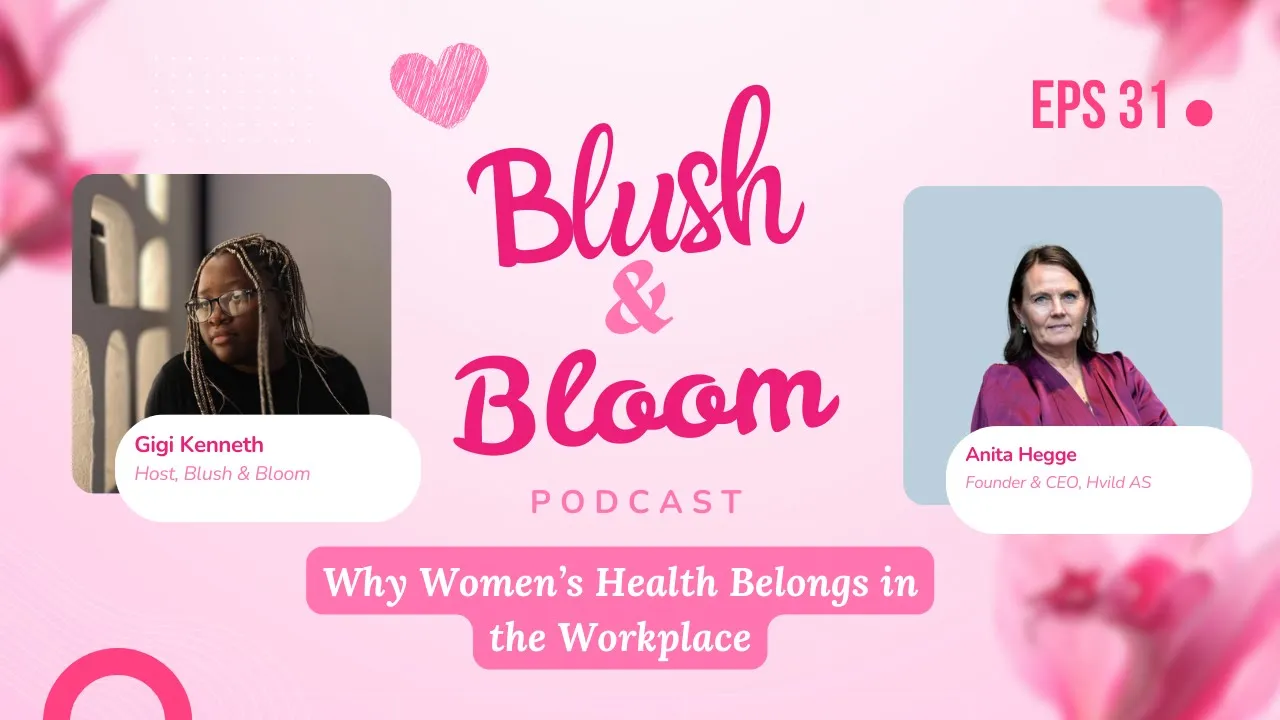
In this episode of Blush & Bloom, host Gigi Kenneth talks with Anita Hegge, a women's health entrepreneur and the founder of Hvild in Oslo, Norway. Hvild works with big companies on women's health in the workplace, runs a digital platform for HR, managers, employees, and safety representatives, and has launched what Anita describes as the world's first menopause insurance.
Together they unpack why so many symptoms go untreated, how stigma shapes workplace culture, and what leaders, HR teams, and women themselves can actually do to make work a safer place for every life phase.
In This Episode, We Cover:
- Why women's health is still missing from most workplace policies
- How menopause, periods, endometriosis, and fertility struggles affect careers
- The world's first menopause insurance and the gaps in existing health insurance
- Anita's own story: breast cancer treatment that pushed her into untreated menopause
- The difference between equality and equity in the workplace
- Why women live longer but spend more years in poor health
- How to build the business case for women's health with facts and numbers
- Filtering good health information from wellness washing and misinformation
Why is women's health at work still so misunderstood?
The biggest misunderstanding, Anita says, is that menopause is just hot flashes and bad sleep. In reality it brings cognitive symptoms too, brain fog and a shrinking sense of confidence, layered on top of a long-standing stigma that treats the whole subject as too personal to discuss. Because it stayed a taboo, the knowledge never spread, and workplaces kept treating a health issue as a private problem.
That silence has a price. As Anita puts it, one in five women don't seek a promotion in their current job because they've lost their confidence, and sick leave among women runs high. The symptoms are real, biological, and treatable, but only if people are allowed to name them.
Turning a personal crisis into a company
Anita's path ran through finance, change management, and building yoga studios across the Nordics before she landed in FemTech. The thread connecting all of it, she says, is a drive to make change in areas she cares deeply about.
The specific moment came from her own body. Years ago she went through breast cancer treatment, and the chemo and radiation pushed her into menopause without anyone warning her.
"So I was happy to survive and I kept on working, but I still, I got this symptom and I got the symptoms harder and harder and harder. I was still working, but I really had a low energy. I actually, I didn't want to be here."
She lived with untreated symptoms for around 12 years before getting help. When treatment finally worked and she felt like herself again, she decided no woman in a workplace should have to go through what she did. That became Hvild.
💼 How do you make the business case for women's health?
Lead with facts, not feelings. Anita approaches leaders with the numbers first: the difference between men and women is biological, the consequences of ignoring it are measurable, and the upside is concrete. Frame it well and there's huge potential to keep women in work longer, lower sick leave, and let them use their full potential.
If the numbers alone don't land, she points to the legal framework, including UN sustainability goals and Norway-specific workplace laws. The goal is never to forget men, she stresses, but to acknowledge that women need support too. It is a business case, not a favor.
Equality is not the same as equity
Norway has some of the world's best maternity protections, yet women still face disadvantages around maternity leave and menopause. Anita's explanation is that the entire work life was built around a default worker, a man of about 75 kilos in an industrial job, and simply adding women to that structure was never enough.
"We have fought so hard for equality and that's been a good thing. But now we need to change the view and really think about equity. That we need different things to have a fair chance to do the same thing."
Policy, she argues, is only half the story. A manager can say all the right things to a woman's face and still quietly pass her over because they assume she's planning to get pregnant. When that happens, everything falls apart. Culture and language have to support the policy, or the policy is just a checkbox.
Why do women live longer but not healthier?
Anita points to widely cited reports showing women live longer than men but spend around 25 percent more of their lives in poor health. The common assumption is that this happens at the very end of life. It doesn't. When you break the numbers down, it starts when women get their first cycle and continues through every life phase: menstruation, conditions like endometriosis and PMDD, pregnancy, the return to work, perimenopause, and menopause.
That reframing matters. The extra years of poor health are spread across a woman's whole life, not saved up for old age, which is exactly why workplaces and healthcare can't keep treating it as a fringe concern.
The promise of FemTech, and the risk of wellness washing
Anita calls FemTech a game changer. It's accelerating new treatments and faster diagnosis, and just as importantly it builds a community that keeps making the case for investing in an area that's been underfunded for far too long. She's especially hopeful about new science on endometriosis and using AI to shorten a diagnostic journey that can currently take young women seven to ten years.
But she's wary of what she calls wellness washing: products marketed hard to women that don't actually help. Her advice is to stay informed so you can make good choices and not spend money on, for example, a stick test that claims to pinpoint where you are in perimenopause when the science isn't there yet. Save that money, she says, at least for now.
FAQ
What does Hvild do? Hvild is a Norway-based company focused on women's health in the workplace. It consults with large companies, runs a digital platform for HR teams, managers, employees, and safety representatives, and has launched what Anita describes as the world's first menopause insurance.
Why isn't women's health covered by regular health insurance? Anita says awareness that women's health is often excluded from health insurance is very low, so many women only discover the gap when they seek support and find it isn't there. Part of Hvild's work is raising that awareness with both employers and women.
What's the difference between equality and equity at work? Equality treats everyone the same. Equity recognizes that women may need different kinds of support to have a fair chance at the same outcomes. Anita argues workplaces built around a single default worker need an equity mindset, not just equal rules.
How can someone raise women's health at work without stigma? Approach it in a non-personal, neutral way, Anita suggests. Ask openly what the organization's position on women's health should be, then break it down team by team, back it with facts and numbers, and focus on building a safe space and shared language.
How do you find trustworthy women's health information? Look to established sources for the specific topic. For menopause, Anita points to the British Menopause Society, which maintains lists of quality information, and suggests trusting profiles that reference reputable societies. When in doubt, talk to someone you trust, and rethink the conversation with your own doctor rather than expecting them to know everything.
💬 Final Thoughts
Anita's core message is simple: be informed. Read, listen, follow good sources, understand the life phase you're in, and then tell at least five other people what you've learned so the knowledge keeps spreading. Women's health at work isn't a perk or a nice-to-have. It's biology, it's a business case, and it's a culture question that policy alone can't solve. The workplaces that get there first will be the ones that stop treating half their workforce as an afterthought.
👥 Connect with the Guest
Anita Hegge: https://www.linkedin.com/in/anita-hegge-2aba95/
Gigi Kenneth (Host): https://www.linkedin.com/in/gigikenneth
💕 Explore More from Asele
Visit: https://www.asele.tech
Try the Asele app: https://asele.health
Join our WhatsApp community: https://chat.whatsapp.com/F8GY4RV7Bm2CtCfq6TONsV
LinkedIn: https://linkedin.com/company/asele
Spotify: https://open.spotify.com/show/6NEsMfkG3dvl0pYXU40Efi
← Back to The Journal