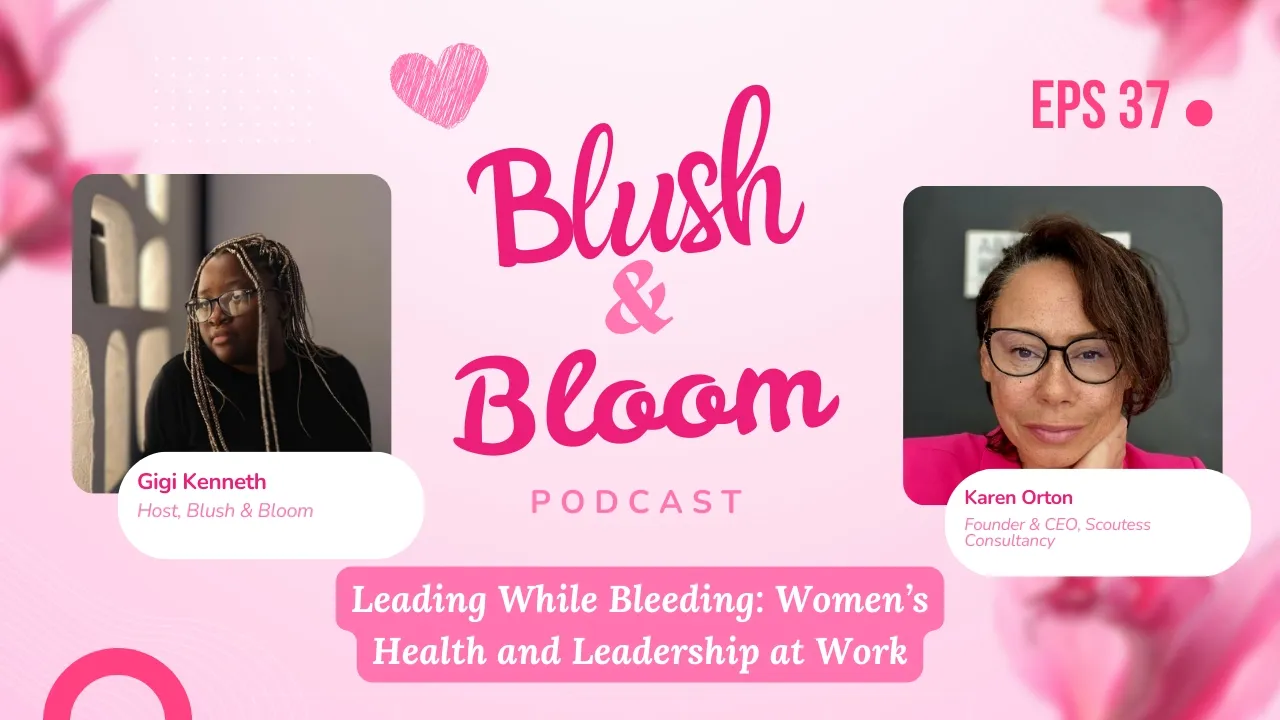
Leading While Bleeding: Health, Burnout, and Leadership | Blush & Bloom Podcast | Ep. 37
Women's health at work is a leadership issue, not a wellbeing footnote. Karen Orton on burnout, cycle awareness, and the Leading While Bleeding Summit.
Most workplaces were built around a body that never bleeds, never cycles, and never runs out of energy. For decades, women's health at work has been filed under soft wellbeing, a perk rather than a performance question. What happens when you treat it as a leadership and governance issue instead?
In this episode of Blush & Bloom, host Gigi Kenneth talks with Karen Orton, founder of Scoutess Consultancy and co-founder of Steer24. After more than two decades in talent and executive hiring, Karen now helps organisations build leadership pipelines around sustainable performance rather than burnout, working at the point where, as she puts it, ambition, biology, and power meet.
Together they unpack why burnout is getting worse for women, what it means to design work around rhythm instead of constant availability, and the thinking behind the Leading While Bleeding Summit, a first-of-its-kind gathering that reframes women's health as a boardroom concern.
In This Episode, We Cover:
- Why women's health belongs in the leadership and governance conversation, not the wellbeing one
- How burnout is showing up for women at work, and why it is getting worse
- Cycle awareness, energy, and what redesigning performance around rhythm looks like
- The idea behind the Leading While Bleeding Summit and who it convenes
- Why so many women hesitate to talk about health at work
- The business cost of ignoring women's health, from attrition to talent pipelines
- Books that shaped Karen's thinking, and what she would tell her younger self
Why should women's health be a leadership issue, not a wellbeing one?
Because health quietly shapes how people lead, decide, and stay. Karen argues that treating women's health as a soft wellbeing topic keeps it off the agenda where it actually matters: role design, metrics, sponsorship, and retention. Seen through an organisational lens rather than a purely clinical one, it becomes a question of governance and sustainable performance.
Karen's own path bears this out. She spent years placing thousands of women into senior roles before noticing how often their health and life stages were shaping their trajectories in ways no one was naming. That realisation led her to co-found Steer24 and to reframe her work at Scoutess Consultancy around helping organisations choose their leaders wisely, not just diversely.
"My work sits where ambition, biology, and power meet. And personally, I care deeply about making sure success doesn't come at the cost of well-being."
🔥 Why is burnout getting worse for women?
Because the pressure is compounding while the systems stay the same. Karen points to relentless uncertainty, geopolitical, economic, and driven by rapid change in tech, as a constant stress activator, layered on top of cycles, life stages, and caring responsibilities that mostly go unseen. After 25 years in talent, she describes the current picture bluntly.
"I've been in talent for 25 years and this is the worst I've ever seen it."
The fix, she insists, is not women learning to fix themselves. It is organisations redesigning what performance looks like, building transparent metrics, and creating cultures that make it safe to be honest about capacity.
🌿 What does redesigning work around rhythm actually mean?
It starts with role clarity and an honest picture of energy. Karen encourages leaders to define what a role really needs today and 12 to 18 months out, and to be clear about accountability and decision-making ownership. From there, the deeper shift is acknowledging that energy and performance are not constant across a month or a career.
She is careful about what this asks of leaders. They do not need to become cycle experts. They need to accept that women's bodies work differently and to give people room to time important decisions and demanding work with their own patterns rather than against them.
"We've been programmed and traditional leadership is about having a constant level of energy, a constant level of availability. That's impossible."
🩸 The Idea Behind the Leading While Bleeding Summit
The Leading While Bleeding Summit grew out of stories Karen kept hearing, women in real pain who still showed up, said nothing, and pushed through. The title lands differently in different rooms, which is part of the point. It is framed deliberately as a leadership event, not a wellness one, complete with metrics, pathways, and sponsorship.
The summit convenes a broad ecosystem: clinicians, policymakers, women with lived experience, and male allies, alongside legal experts who can speak to risk and mitigation. The aim is to move the conversation past gestures and into structures organisations can actually build on.
🤐 Why do women hesitate to talk about health at work?
Because many still fear it will be read as weakness. Karen names the worry directly: that naming a health need could count against you in a culture that prizes constant availability. Her answer is better language, clearer plans, and more transparency, held honestly against what she calls a wider climate of mistrust that makes openness harder for everyone.
Gigi connects this to a pattern that shows up across regions, where women are told that pain, exhaustion, and disruption are simply normal and to be endured. The result is the same either way: silence, delayed support, and problems that compound.
💷 The Business Cost of Ignoring Women's Health
This is where the wellbeing framing falls apart. Karen points to burnout affecting a markedly higher share of women than men, to the enormous economic value lost through female attrition, and to talent pipelines running dry in tech, with large numbers of women considering leaving or already gone. She also flags how few women are in the rooms where AI is being built, which shapes the tools everyone will use next.
Her point is not guilt, it is governance. When health is recognised in the boardroom as a leadership issue, and leadership development is built around rhythm and sustainable performance, retention and results follow. Ignoring it is not neutral, it has a price.
📚 Books, and Advice to Her Younger Self
Karen names a few books that shaped her thinking, including Shared Sisterhood by Tina Opie and Beth A. Livingston, From Strength to Strength by Arthur C. Brooks, and Nicholas Janni's work on leadership and presence. Asked what she would tell her younger self, her answer is simple and quietly radical: you are not too much.
"You just have to find your rhythm, be comfortable with who you are, and honestly, just go for it."
FAQ
Is women's health at work a wellbeing issue or a leadership issue? Karen Orton argues it is a leadership and governance issue. Framing it as soft wellbeing keeps it off the agenda where decisions about roles, metrics, sponsorship, and retention are actually made.
What is the Leading While Bleeding Summit? It is a first-of-its-kind summit that reframes women's health as a leadership concern rather than a wellness one. It convenes clinicians, policymakers, women with lived experience, male allies, and legal experts to build practical structures inside organisations.
Why is burnout worse for women right now? Constant uncertainty and change act as ongoing stress activators, layered on top of cycles, life stages, and caring responsibilities that often go unseen, while workplace systems have not been redesigned to account for any of it.
Do leaders need to become experts on menstrual cycles? No. Karen's point is that leaders do not need clinical expertise. They need to acknowledge that energy and performance vary, and to give people room to time decisions and demanding work with their own patterns.
What can organisations do to support women's health without treating it as an afterthought? Start with role clarity, build transparent performance metrics, design leadership development around rhythm and sustainable performance, and treat health as governance, moving past one-off gestures toward real pathways and sponsorship.
💬 Final Thoughts
The through-line of this episode is a reframe. Women's health at work stops being a perk to be tolerated and becomes a design question for how organisations lead. When leaders build around rhythm instead of constant availability, when health sits in the boardroom as governance rather than in a wellbeing footnote, and when women no longer have to lead while quietly bleeding, everyone gets a more honest, more sustainable way to work.
👥 Connect with the Guest
Karen Orton: https://www.linkedin.com/in/karen-orton-5993a720/
Gigi Kenneth (Host): https://www.linkedin.com/in/gigikenneth
💕 Explore More from Asele
Visit: https://www.asele.tech
Try the Asele app: https://asele.health
Join our WhatsApp community: https://chat.whatsapp.com/F8GY4RV7Bm2CtCfq6TONsV
LinkedIn: https://linkedin.com/company/asele
Spotify: https://open.spotify.com/show/6NEsMfkG3dvl0pYXU40Efi
← Back to The Journal