Endometriosis vs PCOS: How to Tell Them Apart
Endometriosis and PCOS get confused all the time. They can both wreck your periods and affect fertility, but they are two different conditions with different causes. Here is how to tell them apart, and why it matters for getting the right care.
TL;DR: Endometriosis and PCOS are two separate conditions that often get mixed up because both can cause painful, irregular periods and affect fertility. Endometriosis is when tissue similar to the uterine lining grows outside the uterus, and its hallmark is severe, life-disrupting pain. PCOS is a hormonal and metabolic condition driven by excess androgens (so-called male hormones), and its hallmarks are irregular or missing periods, unwanted hair growth, acne, and insulin resistance. You can have one, the other, or both. Getting the right diagnosis changes the treatment completely.
If you have spent any time searching your symptoms online, you have probably run into both names: endometriosis and PCOS (polycystic ovary syndrome). They come up in the same conversations, the same support groups, and often the same doctor's office. It is common to walk away unsure which one you might have, or whether they are even different things.
They are different. Very different, in fact, once you look past the symptoms they happen to share. The confusion is understandable, and it is worth clearing up, because the treatment for one does very little for the other.
Let us break it down.
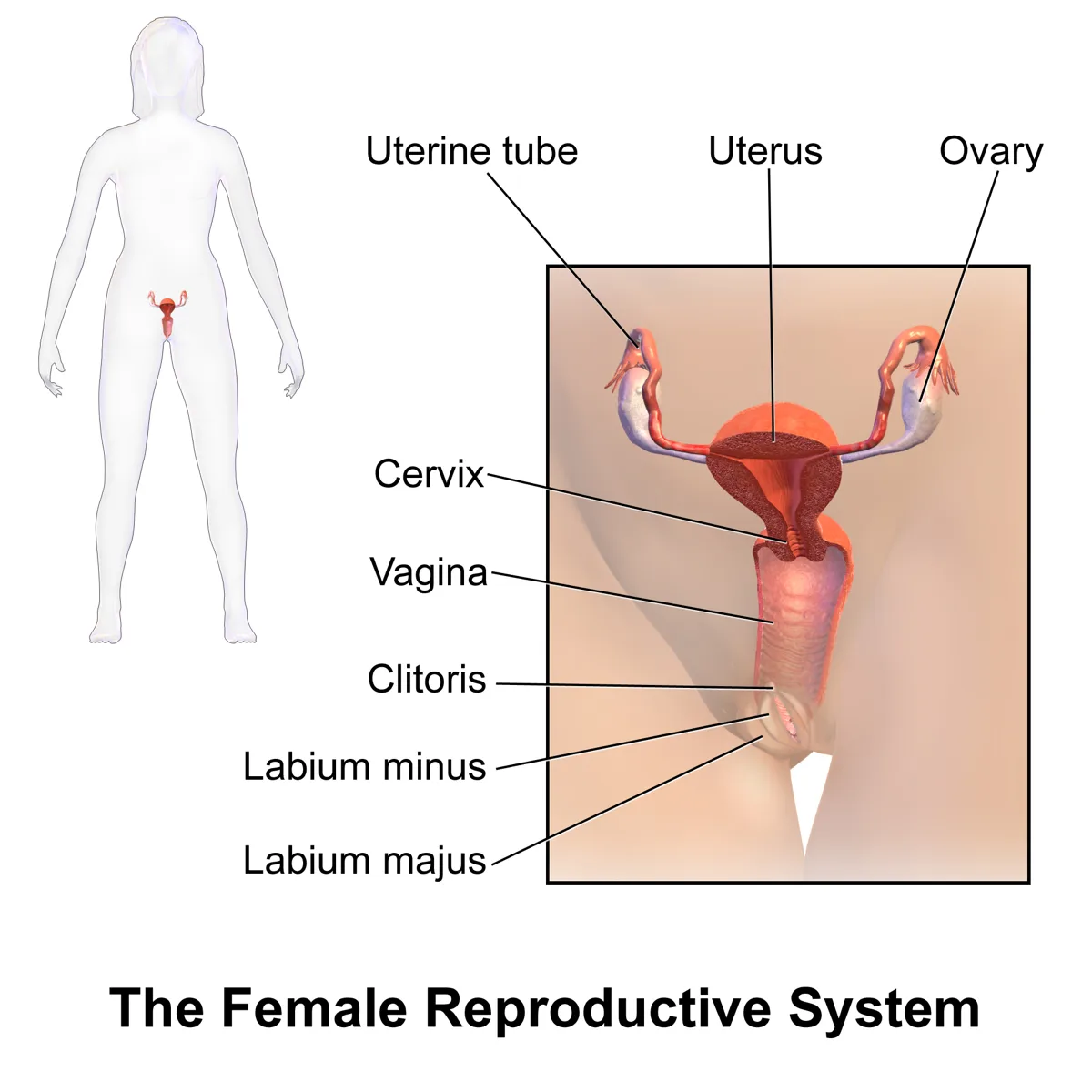
A quick map of the female reproductive system. Both conditions involve these organs, but in different ways. Illustration by Blausen Medical (BruceBlaus), CC BY 3.0.
Why People Confuse the Two
Both conditions can turn your cycle into a source of stress, and they overlap on a few loud symptoms:
- Both can cause period problems. Endometriosis is known for severe pain. PCOS is known for irregular or missing periods. But there is crossover: endometriosis can cause heavy bleeding too, and some women with PCOS have painful cycles.
- Both can affect fertility. Each is a leading cause of difficulty getting pregnant, so they come up together in fertility conversations.
- Both are underdiagnosed, especially in African women. Period pain gets normalised, reproductive-health talk carries stigma, and specialist care is hard to reach. So women with either condition tend to wait years for answers.
- Both involve the ovaries in the imaging. This one causes the most mix-ups. Endometriosis can form cysts on the ovaries (endometriomas, or "chocolate cysts"). PCOS can show many small follicles on an ultrasound that get loosely called "cysts." Different things, similar-sounding words.
So the symptoms rhyme. The underlying problem does not.
What Endometriosis Is
Endometriosis is a condition where tissue similar to the endometrium, the lining of your uterus, grows outside the uterus, on the ovaries, fallopian tubes, bowel, bladder, and elsewhere in the pelvis. That tissue still responds to your monthly hormones, so it thickens and bleeds with each cycle, but the blood has nowhere to go. The result is inflammation, scar tissue, and pain.
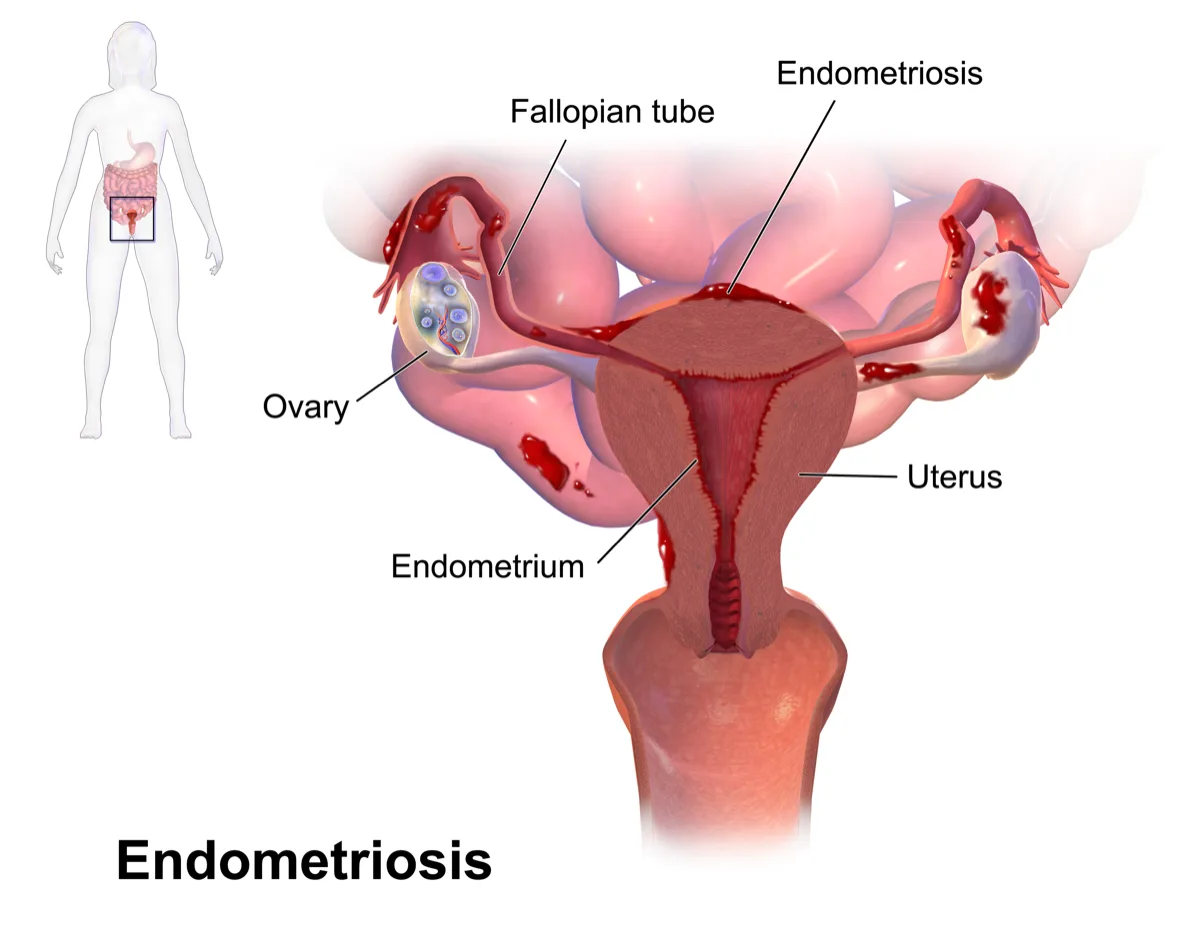
Endometriosis: tissue similar to the uterine lining grows outside the uterus, on the ovaries and surrounding organs. Illustration by Blausen Medical (BruceBlaus), CC BY 3.0.
The defining feature is pain. Not ordinary cramps, but pain that stops you mid-sentence, keeps you home, and dreads the calendar.
For the full picture, see our detailed guide: Endometriosis Explained.
What PCOS Is
PCOS is a hormonal and metabolic condition. The core problem is that the ovaries produce too much androgen (hormones like testosterone that everyone has, but which are higher than they should be here). That hormonal imbalance disrupts ovulation, which is why periods become irregular or stop, and it drives the visible symptoms like acne and unwanted hair growth. Many women with PCOS also have insulin resistance, which links it to weight, blood sugar, and long-term risks like type 2 diabetes.
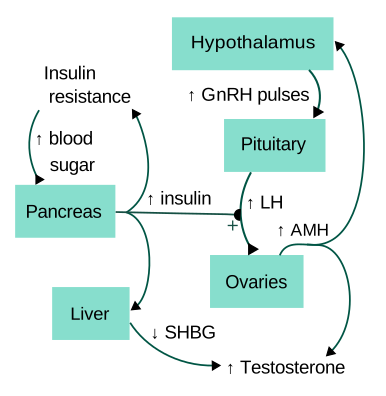
How PCOS develops: raised androgens and insulin resistance interfere with ovulation, which is why the periods stall. Illustration by Femke, Wikimedia Commons, CC BY 4.0.
So PCOS is not an "ovary disease." It is a whole-body hormonal condition that shows up in the ovaries. That reframe matters, and it is one many women are never given.
The name is changing to reflect this. In 2026, a global consensus led by endocrinologists renamed PCOS to polyendocrine metabolic ovarian syndrome (PMOS), precisely because the condition is endocrine and metabolic, not a disease of ovarian cysts (Endocrine Society, Scientific American). Most patients, clinicians, and search engines still say PCOS, so we use that name here, but the new one tells you where the science stands.
For the full picture, see: PCOS Explained and PCOS Awareness for African Women.
Side by Side: The Key Differences
Here is the quickest way to hold them apart in your head.
Endometriosis, at a glance:
- Root cause: tissue similar to the uterine lining growing outside the uterus
- Type of condition: inflammatory
- Signature symptom: severe pelvic pain, painful periods, pain during sex
- Periods: often heavy and very painful, can be regular or irregular
- Skin and hair: not typically affected
- Weight and blood sugar: not a core feature
- How it is diagnosed: ultrasound or MRI can hint at it, but laparoscopy (keyhole surgery) is the only way to confirm
PCOS, at a glance:
- Root cause: hormonal imbalance with excess androgens, often with insulin resistance
- Type of condition: hormonal and metabolic
- Signature symptom: irregular or absent periods, plus acne and unwanted hair growth
- Periods: infrequent, unpredictable, or missing, usually not the searing pain of endo
- Skin and hair: acne, oily skin, hair growth on the face or body (hirsutism), sometimes scalp hair thinning
- Weight and blood sugar: weight gain and insulin resistance are common
- How it is diagnosed: based on symptoms, blood tests for hormones, and ultrasound (no surgery needed)
The difference in how each is diagnosed matters. PCOS is confirmed with the Rotterdam criteria: you need two of three signs, which are irregular ovulation, high androgens (by symptoms or blood test), and many follicles on an ultrasound. No surgery is involved. Endometriosis has no such checklist, and confirming it often needs keyhole surgery, which is part of why it takes so many years to diagnose.
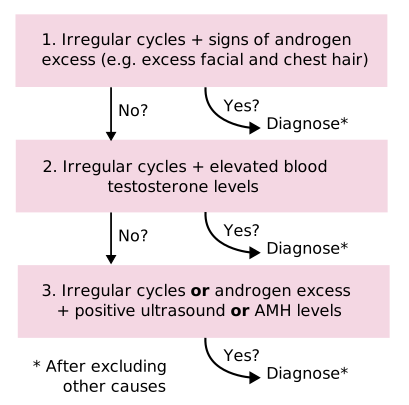
The Rotterdam criteria for diagnosing PCOS: two of three signs are enough. Illustration by Femke, Wikimedia Commons, CC BY 4.0.
A Simple Rule of Thumb
If your main story is pain, pain that dominates your period and your life, endometriosis belongs on the list of things to investigate.
If your main story is missing or unpredictable periods alongside skin and hair changes and weight or blood-sugar struggles, PCOS belongs on the list.
This is a rule of thumb, not a diagnosis. Symptoms overlap, and only a proper medical work-up can confirm either one.
Can you have both endometriosis and PCOS?
Yes. Having PCOS does not protect you from endometriosis, and the reverse is also true. Some women live with both at once, which makes for a confusing symptom picture: the irregular periods and hormonal signs of PCOS layered over the pain of endometriosis. If your symptoms seem to belong to both lists, that is worth saying out loud to your doctor rather than assuming it has to be one or the other.
How They Are Treated (and Why the Difference Matters)
This is why getting the right label matters.
Endometriosis treatment focuses on managing pain and slowing tissue growth: anti-inflammatory pain relief, hormonal therapy to lower estrogen, and, in many cases, laparoscopic surgery to remove the tissue. Nutrition and pelvic floor support help too. See our post on easing menstrual cramps through nutrition.
PCOS treatment focuses on restoring hormonal balance and managing the metabolic side: lifestyle and nutrition to improve insulin sensitivity, medications to support ovulation or lower androgens, and targeted help for acne or hair growth. The birth-control pill is often prescribed, and it can help, but it is one tool among several, and you deserve to understand why it is being offered.
The overlap in symptoms means a treatment aimed at the wrong condition can leave you frustrated and no better. A woman with endometriosis put on a standard PCOS plan will still be in pain. A woman with PCOS treated only for pain will still not be ovulating.
Getting the Right Diagnosis, Especially in Africa
For many African women, the hardest part is not the biology. It is being heard. Period pain gets dismissed as normal, reproductive health is treated as a private matter, and specialist appointments are short and hard to come by. Both conditions are frequently missed, misread as each other, or lumped together as "just bad periods."
A few things that help:
- Track your symptoms before you go. Note your pain (when, how bad, how long), your cycle length and gaps, and any skin, hair, or weight changes. Our guide on how to track your period walks through simple methods. Patterns on paper are harder to wave away than "I think it hurts a lot."
- Name what you suspect. It is reasonable to say, "I would like to rule out endometriosis," or "Could this be PCOS?" Asking about a specific condition often changes the direction of the appointment.
- Ask what the plan is testing for. If you are handed a prescription, ask which condition it is treating and how you will know if it is working.
- Bring a clear summary to your appointment. Asele's Health Brief is built for this, so a rushed consultation still gets the full story.
If your concerns are brushed aside and your symptoms continue, seeking a second opinion is not being difficult. It is looking after yourself.
Endometriosis vs PCOS: The Difference That Changes Your Care
Endometriosis and PCOS get confused because they share a few of the same headlines: bad periods and fertility worries. But endometriosis is an inflammatory condition defined by pain, and PCOS is a hormonal and metabolic condition defined by disrupted ovulation and androgen excess. The tests are different, the treatments are different, and you can have both.
You do not need to diagnose yourself. You do need enough understanding to ask the right questions and push for a proper answer. That is where it starts.
What is the main difference between endometriosis and PCOS?
Endometriosis is an inflammatory condition where tissue similar to the uterine lining grows outside the uterus, and its hallmark is severe, life-disrupting pain. PCOS (now also called PMOS) is a hormonal and metabolic condition marked by irregular or missing periods, excess androgens, acne, and unwanted hair growth. One is defined by pain, the other by disrupted ovulation.
Is it endometriosis or PCOS if my periods are painful?
Painful periods point more toward endometriosis, whose signature is pain severe enough to disrupt daily life. PCOS is better known for irregular or missing periods than for severe pain, though some women with PCOS do have painful cycles. Only a medical work-up can tell for certain, and you can have both conditions at once.
Does endometriosis or PCOS cause infertility?
Both can affect fertility, which is one reason they get confused. Endometriosis can cause scarring and inflammation that interfere with conception, while PCOS disrupts ovulation. Many women with either condition still conceive, with or without treatment, so a diagnosis is not a verdict on whether you can have children.
What is PCOS called now?
In 2026 a global consensus of endocrinologists renamed PCOS to polyendocrine metabolic ovarian syndrome, or PMOS, to reflect that it is a whole-body hormonal and metabolic condition rather than a disease of ovarian cysts. The PCOS name is still widely used by patients and clinicians, so both names refer to the same condition.
References
- World Health Organization. "Endometriosis." who.int
- World Health Organization. "Polycystic ovary syndrome." who.int
- American College of Obstetricians and Gynecologists. "Endometriosis." acog.org
- American College of Obstetricians and Gynecologists. "Polycystic Ovary Syndrome (PCOS)." acog.org
- Eunice Kennedy Shriver National Institute of Child Health and Human Development (NICHD). "Polycystic Ovary Syndrome (PCOS)." nichd.nih.gov
- Endometriosis Foundation of America. "What Is Endometriosis?" endofound.org
- Endocrine Society. "Polyendocrine Metabolic Ovarian Syndrome: New name to improve diagnosis and care." 2026. endocrine.org
- Scientific American. "PCOS Just Got a New Name. Here's What to Know." 2026. scientificamerican.com
Image credits
- Female reproductive system and endometriosis illustrations: Blausen Medical (BruceBlaus), from "Medical gallery of Blausen Medical 2014," WikiJournal of Medicine, CC BY 3.0, via Wikimedia Commons (anatomy, endometriosis).
- PCOS mechanism and diagnosis illustrations: Femke, CC BY 4.0, via Wikimedia Commons (mechanism, diagnosis).
Related posts on Asele:
← Back to The Journal