The Cervical Screening Gap: Why Black and Minority Women in the UK Miss Out
Cervical screening is one of the most effective cancer-prevention tools we have, yet Black and minority-ethnic women in the UK attend less often. Here is why the gap exists, what the appointment involves, and how to book with confidence.

TL;DR: Cervical screening (the smear test) checks for HPV, the virus behind almost all cervical cancer, so problems can be caught and treated long before they turn into cancer. In the UK it is offered free on the NHS from age 25. Black and minority-ethnic women, and women in deprived areas, are less likely to attend, often because of fear, past bad experiences, stigma, and practical barriers rather than lack of care about their health. You can request a female nurse, ask for more time, and take the test at your own pace. Booking one appointment is one of the most protective things you can do for yourself.
If you have a letter sitting on the kitchen table inviting you to book a smear test, and you have quietly moved it to the bottom of the pile more than once, you are not alone. Cervical screening is one of the most effective forms of cancer prevention we have, yet plenty of women put it off, and Black, African, and minority-ethnic women in the UK put it off more than most.
This is not about blame. The reasons are valid and understandable, and many of them have nothing to do with how much you value your health. What follows is a plain look at what screening is, why the gap exists, and how to make the appointment feel less daunting, so that a test designed to protect you does exactly that.

How cervical screening works: a small sample of cells is taken from the cervix and checked in a laboratory. Illustration by DataBase Center for Life Science (DBCLS), CC BY 4.0.
What Cervical Screening Is and Why It Matters
Cervical screening, still widely called a smear test, is a quick check of the cells of your cervix, the lower part of the womb that opens into the vagina. A nurse uses a soft brush to collect a small sample of cells, which is then tested in a lab.
The important shift in recent years is what the lab looks for first. Most cervical screening in the UK now uses HPV primary screening: the sample is tested for high-risk types of human papillomavirus (HPV), the common virus responsible for almost all cervical cancers. If HPV is not found, your risk is very low and you simply carry on with routine screening. If it is found, the same sample is checked for cell changes so anything unusual can be watched or treated early.
That is the whole point. Screening is not a cancer test. It is a way of catching changes years before they could ever become cancer, when they are simple to treat. According to Cancer Research UK, screening prevents a large share of cervical cancer cases, and the World Health Organization counts cervical cancer among the most preventable and treatable cancers when caught early. For a fuller explainer on HPV and how the test protects you, see our guide to cervical cancer and HPV screening.
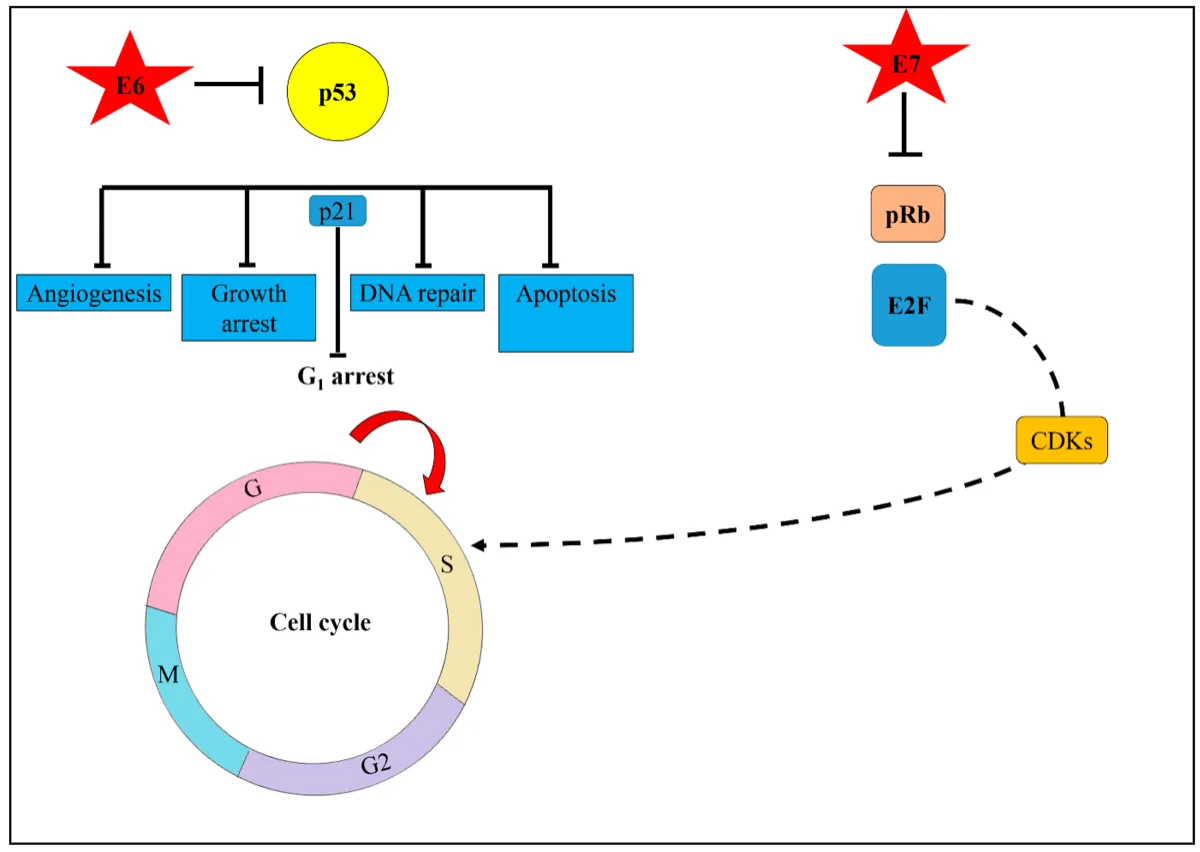
Persistent high-risk HPV can slowly drive cell changes in the cervix. Screening catches those changes early, long before cancer. Illustration from Balasubramaniam et al., via Wikimedia Commons, CC BY-SA 4.0.
The Gap: Who Misses Out, and by How Much
Screening in England works on an invitation system, and uptake is measured closely. The picture is uneven. Attendance is lower among women from Black, Asian, and other minority-ethnic backgrounds, and lower again in more deprived areas, a pattern documented by the NHS Race and Health Observatory and by Jo's Cervical Cancer Trust, the UK charity dedicated to cervical health.
The consequence is not abstract. When screening is missed, cancers are found later, when they are harder to treat. A gap in attendance becomes a gap in survival. The encouraging part is that this is one of the most fixable inequalities in women's health, because the barriers are known, and most of them can be worked around.
Why the Barriers Run Deep
The reasons women delay or avoid screening tend to cluster, and research from Jo's Cervical Cancer Trust and others keeps finding the same themes.
- Fear and anxiety. Worry that it will hurt, or fear of what the result might show, keeps many women away. The fear is understandable, and it is also usually worse than the reality.
- Past bad experiences. A previous appointment that felt rushed, painful, or dismissive leaves a lasting mark, and a reluctance to repeat it.
- Embarrassment and stigma. In many communities, reproductive and sexual health is a private matter that is difficult to talk about, and a test involving the cervix can feel exposing.
- Misconceptions about HPV. Because HPV is passed on through skin contact, some women fear that a positive result implies infidelity or judgement. HPV is extremely common, most people who have ever been sexually active will carry it at some point, and it says nothing about your character or your relationship.
- Feeling low risk. Women who have had one partner, who are not currently sexually active, or who have had the HPV vaccine sometimes assume they do not need screening. Screening still matters, because the vaccine does not cover every high-risk type and HPV can stay dormant for years.
- Access and time. Appointment times that clash with work or childcare, difficulty getting through to the surgery, and language barriers all add friction.
- Not being heard. For many Black women, the deeper issue is a history of feeling unheard in medical settings, where concerns are minimised. That erodes trust, and trust is what gets you through the door.
Naming these barriers is the first step to getting past them. Nearly all of them can be answered, either by knowing what the appointment involves or by asking for a small adjustment that you have every right to request.
What Happens at the Appointment
Knowing the shape of the appointment removes a lot of the dread. Here is the plain version, drawn from the NHS description of cervical screening.
- The test is done by a female nurse in most GP surgeries and sexual-health clinics. You can ask for a female clinician when you book.
- You undress from the waist down (or you can wear a skirt and simply remove your underwear) and lie back on the couch, usually with a paper sheet over you.
- The nurse gently inserts a smooth device called a speculum to see the cervix, then uses a small soft brush to sweep some cells. The brush part takes seconds.
- It can feel odd or a little uncomfortable, but for most women it is not painful. It is over quickly, often within a couple of minutes.
- You get dressed, and that is it. Results usually arrive by letter within a few weeks.
If you have never had a gynaecological exam before, our guide to your first gynaecologist appointment walks through what to expect in more detail.
How to Remove the Barriers
You are allowed to make the appointment work for you. None of these requests are unusual, and a good clinic will welcome them.
- Ask for a female nurse. You can state this when booking. It is a standard request.
- Ask for more time, or a double appointment. If you feel anxious, say so. A few extra minutes to talk it through changes the whole experience.
- Ask for a smaller speculum. If a previous test was uncomfortable, mention it. The nurse can use a smaller size and plenty of lubricant.
- Bring someone with you. A friend or family member in the waiting room, or in the room, is completely fine.
- Set the pace. You can ask the nurse to explain each step, and you can pause at any point. You are in charge, and you can stop the test whenever you want.
- Ask about self-sampling. In some parts of the UK, a self-sample option is being introduced or trialled, where you can take the swab yourself. Ask your GP or clinic whether it is available to you, and check the latest guidance on gov.uk.
- Time it well. Try to book when you are not on your period, and give yourself an unhurried slot rather than squeezing it between commitments.
If your first language is not English, you can ask for an interpreter, which the NHS provides free. And if a clinic ever makes you feel rushed or dismissed, you are within your rights to rebook with a different nurse or practice.
Believe Black Women, and Be Heard
A great deal of the screening gap comes down to a single thing: whether a woman feels she will be listened to. For Black and African women who have had their pain minimised or their questions brushed aside, the reluctance to sit through another exam is a rational response to how they have been treated, not a lack of care about their own bodies.
Being heard is something you can prepare for. Writing down your questions and any past experiences before you go makes it easier to say what you need, and harder for it to be waved away. Asele's Health Brief is built for exactly this, helping you walk into a short appointment with the full picture ready, so your history and concerns are on the table from the start. If you would rather map out your wider preventive care, our women's health screening checklist lays out what to keep track of and when.
Screening is one thread in looking after yourself. Getting familiar with your own body is another, whether that is a breast self-exam or simply understanding what is normal for you when it comes to vaginal health and discharge. None of it replaces a clinician, but all of it helps you notice when something has changed and speak up sooner.
Closing the Cervical Screening Gap, at Home and in the Diaspora
The cervical screening gap is not only a UK story. In many African countries, organised screening programmes are still being built, and cervical cancer remains a leading cause of cancer death in women, which the WHO is working to change through vaccination and screening. Women who have moved between Lagos, London, and Amsterdam often carry different assumptions about what screening is and whether it applies to them. For a closer look at screening in a Nigerian context, see our piece on the Pap smear in Nigeria.
Asele is built for this reality, a holistic women's-health companion for African women wherever they live, with screening reminders that nudge you when a test is due and a Health Brief that keeps your history with you across borders and clinics. Wherever you are, the principle holds: a short, free test now can spare you a far harder road later.
Book Your Cervical Screening
If you have a screening invitation, or you are 25 or older and cannot remember your last test, the next step is simple. Call your GP surgery or a local sexual-health clinic and book a cervical screening appointment. Ask for a female nurse if that helps, ask for extra time if you are anxious, and go at your own pace.
One appointment. A few minutes. Years of protection. That is a fair trade, and you deserve it.
At what age does cervical screening start in the UK?
In the UK, cervical screening is offered to women and people with a cervix from the age of 25. Between 25 and 49 you are usually invited every three years, and from 50 to 64 every five years, though the exact interval can depend on your results and your nation within the UK. You will normally receive an invitation letter when you are due.
Does a smear test hurt?
For most women a smear test is not painful, though it can feel uncomfortable or a little strange for a minute or two. Feeling tense makes it harder, so slow breathing helps, and you can ask the nurse to use a smaller speculum and plenty of lubricant. Tell the nurse if you feel pain, because the test can be paused or adjusted at any point.
Can I request a female nurse for my smear?
Yes. You can ask for a female nurse or clinician when you book your cervical screening, and most GP surgeries and sexual-health clinics will arrange this as a matter of routine. You can also ask for a longer appointment, bring someone with you, or request an interpreter, all of which are reasonable and common requests.
Do I still need screening if I have had the HPV vaccine?
Yes, you still need cervical screening even if you have had the HPV vaccine. The vaccine protects against the HPV types that cause most cervical cancers, but not every high-risk type, so screening remains an important safety net. The two work together: vaccination lowers your risk, and screening catches any changes the vaccine does not prevent.
References
- NHS. "Cervical screening." nhs.uk
- Jo's Cervical Cancer Trust. Cervical screening and support. jostrust.org.uk
- NHS Race and Health Observatory. nhsrho.org
- Cancer Research UK. "Cervical screening." cancerresearchuk.org
- World Health Organization. "Cervical cancer." who.int
- GOV.UK. "Cervical screening: programme overview." gov.uk
- GOV.UK. "Cervical screening (population screening programmes)." gov.uk
- NHS. "Cervical cancer." nhs.uk
Image credits
- Cervical cancer screening process diagram: DataBase Center for Life Science (DBCLS), CC BY 4.0, via Wikimedia Commons (source).
- HPV carcinogenesis diagram: Balasubramaniam, S.D. et al., "Key Molecular Events in Cervical Malignancy," CC BY-SA 4.0, via Wikimedia Commons (source).
Related posts on Asele:
← Back to The Journal