Why Black Women Face Higher Risks in Pregnancy and Childbirth
Black and African women face higher risks in pregnancy and childbirth, and the reasons are systemic rather than anything about race itself. Here is what the data shows, the warning signs to never ignore, and how to make sure you are heard.

TL;DR: Black and African women are several times more likely to die or be seriously harmed in pregnancy and childbirth than white women, in the UK, the Netherlands, and across much of the world. The cause is not race or biology. It is a stack of systemic factors: being dismissed when you raise a concern, uneven access to good care, and conditions like preeclampsia and anaemia going caught too late. That means the gap is not fixed in stone. Knowing the warning signs and learning how to be heard can change how your pregnancy goes.
If you are Black or African and pregnant, or planning to be, you have probably heard the statistics, and they are frightening. It is worth saying clearly at the start: these numbers describe a system, not your body, and not your fate. Most pregnancies among Black women are healthy and end well. The point of understanding the risk is not to scare you. It is to hand you the information that helps you get the care you deserve.
Let us walk through what the data shows, why the gap exists, the signs that should never wait, and how to advocate for yourself so a busy appointment still hears the full story.
What the Numbers Show
The disparity is well documented, and it has been measured carefully.
In the UK, the MBRRACE-UK programme, which reviews every maternal death in the country, has reported for years that Black women are markedly more likely to die during pregnancy, birth, or the weeks after than white women. The gap has narrowed slightly in recent reports but remains stark, with Black women several times more at risk. Asian women and women from the most deprived areas also face raised risk. You can read the confidential enquiry reports directly on the MBRRACE-UK reports page.
In the Netherlands, a nationwide cohort study found that women of sub-Saharan African origin had roughly 3.5 times the risk of severe acute maternal morbidity, meaning life-threatening complications such as major haemorrhage, eclampsia, or organ failure, compared with the general Dutch population.
Globally, the World Health Organization reports that sub-Saharan Africa carries the heaviest burden of maternal deaths in the world, driven largely by gaps in access to timely, quality care rather than anything inherent to the women themselves.
Different countries, similar pattern. That consistency is the clue. When the same gap shows up in Lagos, London, and Amsterdam, the common thread is not genetics. It is how care is delivered and received.
Why the Gap Exists (and Why It Is Not About Race Itself)
This is the part that gets misreported most, so it is worth being precise. Race is a risk marker here, not a cause. Being Black does not make a pregnancy inherently more dangerous. What raises the risk is a set of things that tend to cluster around Black and African women in these health systems.
Being dismissed or not believed. This comes up again and again in the accounts behind the statistics. Pain gets underestimated. Concerns get waved away as anxiety. A woman raising the same symptom twice is heard differently depending on who she is. When a serious complication is developing, those lost hours matter.
Uneven access to good care. Later booking of antenatal appointments, fewer specialists within reach, language and cost barriers, and care that is not always culturally aware all add up. In many African settings the gap is starker still, with distance, staffing, and emergency transport all in play.
Conditions caught too late. Some complications are more common or hit harder, and the danger multiplies when they are spotted late.
- Preeclampsia, a blood-pressure disorder of pregnancy, is more common and can be more severe in Black women. Caught early it is manageable. Missed, it becomes dangerous fast.
- Anaemia, often from iron deficiency, is widespread and leaves women far less able to withstand blood loss at birth.
- Fibroids, high blood pressure that predates pregnancy, and diabetes are all more prevalent and each raises the stakes.
None of these are destiny. Preeclampsia is monitored at every appointment. Anaemia is a blood test and, often, a supplement. The tragedy is not that these conditions exist. It is that they are sometimes not looked for, or not acted on, in time.
So the clearest framing is this: the disparity is systemic, and systemic problems are fixable. That is not a consolation. It is the reason knowing the warning signs is worth your time.
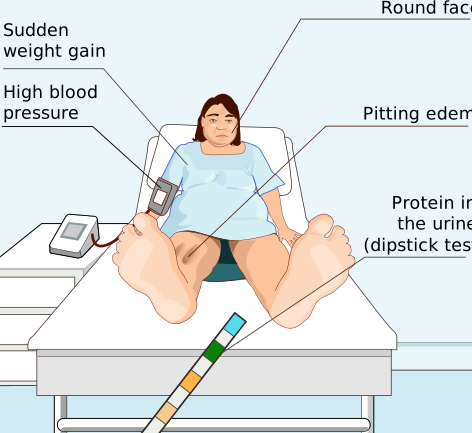
The warning signs of preeclampsia, one of the complications that hits Black women harder when it is caught late. Illustration by Hariadhi, CC BY-SA 4.0, via Wikimedia Commons.
Warning Signs to Never Ignore
Learn these. Say them out loud if you notice them, and ask to be seen the same day. If a symptom is severe or sudden, treat it as an emergency and go straight to your maternity unit or nearest hospital rather than waiting for a routine appointment.
During pregnancy (especially the second half), signs of possible preeclampsia:
- A severe or persistent headache that does not ease with rest or usual pain relief
- Vision changes: blurring, flashing lights, or spots
- Sudden swelling of the face, hands, or feet
- Pain just below the ribs, usually on the right side
- Feeling suddenly and severely unwell
Signs that need urgent attention at any stage:
- Reduced or changed fetal movements. If your baby is moving less than usual, do not wait and do not try to "wake" the baby with cold drinks or noise. Contact your maternity unit straight away, at any hour. The NHS guidance on baby movements is clear that a change is always worth checking.
- Bleeding, severe abdominal pain, a gush or trickle of fluid, or a high temperature.
After birth, in the postpartum weeks:
- Heavy bleeding that soaks a pad in an hour, large clots, or bleeding that suddenly increases
- Signs of infection: fever, foul-smelling discharge, or a painful, hot area
- Chest pain, breathlessness, or a swollen, painful calf, which can signal a blood clot
- A severe headache or vision changes, because preeclampsia can appear or worsen after delivery, not only before
Postpartum risk is often underestimated by everyone, including new mothers themselves. The danger does not end at delivery. Keep watching yourself, and keep speaking up, through those first six weeks.
Your Mind Matters Too
Maternal health is not only about blood pressure and bleeding. Postnatal depression and postpartum anxiety are common, treatable, and too often missed in Black women, partly because of stigma and partly because clinicians do not always ask. Feeling persistently low, tearful, numb, panicky, or unable to sleep even when the baby sleeps is not weakness and not something to push through alone.
Our guides on postpartum depression and on anxiety and depression in women go deeper, and both come back to the same point: telling someone is the first treatment. If you ever have thoughts of harming yourself or your baby, that is a reason to seek help immediately.
How to Advocate for Yourself and Get Taken Seriously
You should not have to fight to be heard. In an unequal system, though, a few habits genuinely shift the odds in your favour.
Track your symptoms, with dates and detail. Vague worry is easy to wave away. A written record of when a symptom started, how bad it is, and how it is changing is much harder to dismiss. Note your blood pressure readings if you have them, your baby's movement patterns, swelling, headaches, and how you are feeling in yourself.
Name your concern plainly and ask for it to be documented. Saying "I am worried this could be preeclampsia, please can you check my blood pressure and urine" gives the appointment direction. If you are brushed off, it is reasonable to ask, "Can you write in my notes that I raised this?" That request alone often changes how seriously a concern is taken.
Use the phrase that unlocks urgency. "I need this checked today" and "I do not feel right, and this is not normal for me" are worth saying clearly. You know your body.
Bring a clear summary to every appointment. Rushed consultations lose detail, and detail is exactly what protects you. Asele's Health Brief pulls your tracked symptoms, readings, and history into one clear summary you can hand over or read from, so the full story arrives even when the appointment is short. It is built for this moment: making sure a ten-minute visit still gets the whole picture.
Bring someone with you if you can. A partner, friend, or relative who can listen, take notes, and repeat a concern is not being difficult. They are a second voice when yours is tired.
Ask for a second opinion when something is wrong and not being addressed. Persistent symptoms that keep getting dismissed are a reason to push, not to back down. Seeking another view is your right, not a nuisance.
Good nutrition and steady antenatal care sit underneath all of this. Our pregnancy nutrition guide covers the basics that lower risk, including the iron and folate that guard against anaemia, and our note on breastfeeding challenges helps with the weeks after.
Black Maternal Health Is a Gap We Can Close
Closing the Black maternal health gap is work for health systems: training that roots out bias, care that reaches women earlier and listens harder, and data that keeps everyone accountable. That is not something any individual can carry alone, and it should not be on your shoulders.
What is in your hands is smaller and still powerful. Knowing the warning signs. Booking care early. Keeping a record. Speaking plainly and asking for a second opinion when you need one. Our overview of health risks and prevention for African women and our women's health screening checklist both fit alongside this, because the same habits that protect you in pregnancy protect you across your whole health.
Why are Black women more likely to die in childbirth?
Black women are several times more likely to die in pregnancy or childbirth than white women in countries like the UK, and the reasons are systemic rather than biological. Concerns are more often dismissed, access to timely quality care is uneven, and complications such as preeclampsia and anaemia are sometimes caught too late. Race is a marker for these factors, not a cause. Because the drivers are systemic, the gap is not inevitable, and early care, symptom tracking, and self-advocacy all help.
What are the warning signs of preeclampsia?
The key warning signs of preeclampsia are a severe or persistent headache, vision changes such as blurring or flashing lights, sudden swelling of the face, hands, or feet, and pain just below the ribs, usually on the right. It can develop in the second half of pregnancy or even after birth. Preeclampsia is a serious blood-pressure disorder, so if you notice these signs, contact your maternity unit the same day and treat sudden or severe symptoms as an emergency.
How can I advocate for myself during pregnancy?
Track your symptoms with dates and detail, name your concern plainly, and ask for it to be written in your notes. Say clearly when you need something checked today, and bring a clear summary of your history and readings to every appointment so a short visit still gets the full picture. Bringing a companion helps, and asking for a second opinion when a concern keeps being dismissed is your right. Tools like the Asele Health Brief are built to make you heard in a rushed consultation.
Does reduced fetal movement mean something is wrong?
A change in your baby's movements is always worth checking, and you should never wait or try to prompt the baby with food, drinks, or noise. Reduced or altered movement can sometimes be an early sign that a baby is unwell, so contacting your maternity unit straight away, at any hour, is the right thing to do. Most of the time everything is fine, but the check matters, and midwives would far rather you called than stayed home worrying.
References
- MBRRACE-UK, National Perinatal Epidemiology Unit, University of Oxford. "Mothers and Babies: Reducing Risk through Audits and Confidential Enquiries across the UK." npeu.ox.ac.uk
- MBRRACE-UK. "Maternal and perinatal mortality reports." npeu.ox.ac.uk
- Zwart JJ, Jonkers MD, Richters A, et al. "Ethnic disparity in severe acute maternal morbidity: a nationwide cohort study in the Netherlands." European Journal of Public Health, 2011. pubmed.ncbi.nlm.nih.gov
- World Health Organization. "Maternal mortality." who.int
- World Health Organization. "Anaemia." who.int
- NHS. "Pre-eclampsia." nhs.uk
- Royal College of Obstetricians and Gynaecologists. "Pre-eclampsia (patient information)." rcog.org.uk
- NHS. "Your baby's movements in pregnancy." nhs.uk
- NHS. "Postnatal depression." nhs.uk
Image credits
- Preeclampsia symptoms diagram: Hariadhi, CC BY-SA 4.0, via Wikimedia Commons (file).
Related posts on Asele:
← Back to The Journal