Online Safety for Women in Africa, with Yasmin Ahmed | Blush & Bloom Podcast | Ep. 45
Lawyer Yasmin Ahmed on online safety for women in Africa, women's digital rights, the digital divide in Uganda, and privacy built in by design.
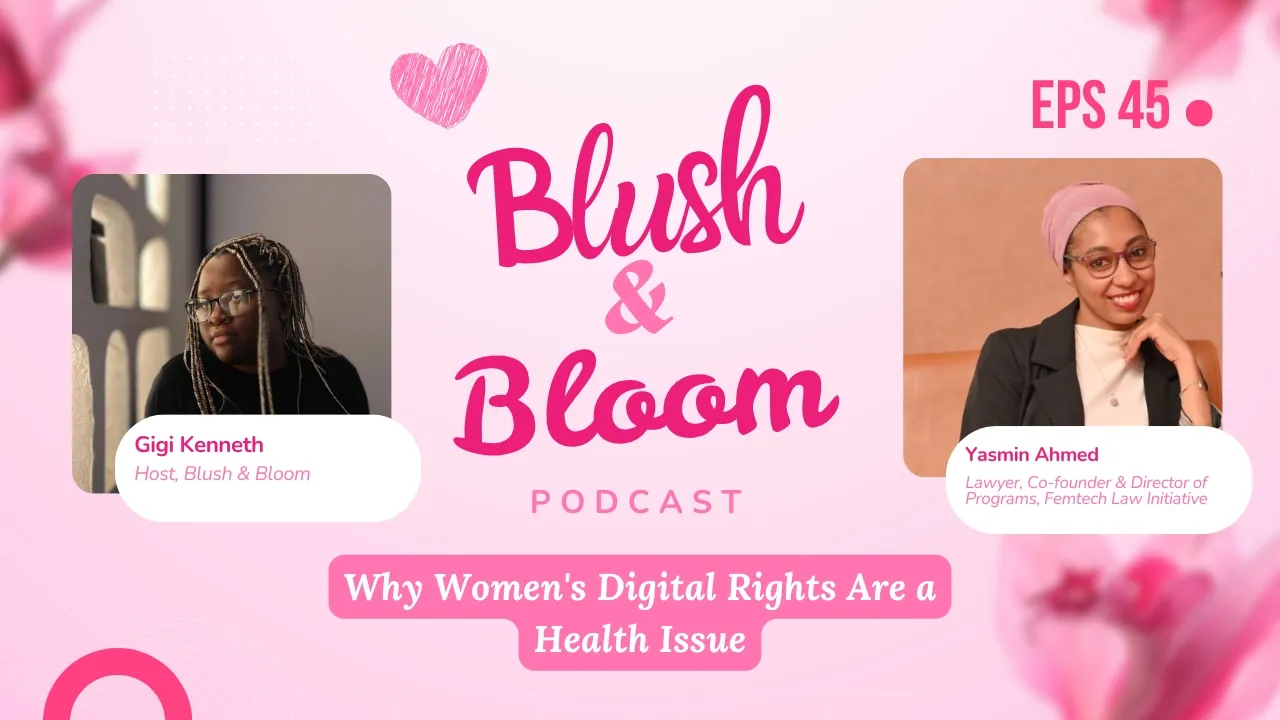
Online safety for women in Africa is not a niche legal concern. It is a health issue, a rights issue, and increasingly a technology one. On this week's Blush & Bloom, Gigi Kenneth sits down with Yasmin Ahmed, a lawyer working at the intersection of law, technology, and human rights and the founder of the FemTech Law Initiative, a pan-African effort based in Uganda focused on inclusion, safety, and equitable access to technology for women and girls.
Yasmin's work starts from a simple premise: the harms women face online are real, escalating, and often invisible to the people writing the rules. As she puts it, "I was worried about the creep that lives next door, now I'm also worried about the creep that is on my phone." The conversation moves from harassment and image-based abuse to data privacy, the digital divide, and the AI harms that are getting harder for women to fight.
In This Episode, We Cover:
- How law, technology, and human rights come together as a career path
- Online safety for women and girls: harassment, hate speech, and image-based abuse
- Why a personal mental-health turning point led Yasmin to found the FemTech Law Initiative
- Digital rights framed as women's health, including SRHR and telemedicine data
- The digital divide in Uganda: device access, digital literacy, and language barriers
- Data protection, "privacy by design," and a real Uganda court case
- AI harms: deepfakes, voice cloning, and algorithmic amplification
- Who is responsible for keeping women safe online
What does online safety for women in Africa really mean?
It means protection from the harms women disproportionately face on the internet: harassment, hate speech, image-based abuse, and outright exclusion from digital spaces. Yasmin frames it as personal and constant. The threat is no longer only physical proximity. It follows women onto their phones, into their inboxes, and across every platform they use.
Why did Yasmin found the FemTech Law Initiative?
The FemTech Law Initiative grew out of a difficult personal chapter. A workplace issue took a serious toll on Yasmin's mental health and forced her to take a year off. Rather than leave that experience behind, she turned it into purpose, building an organisation to protect other women and girls. "The power to change your life, to change others' lives, lies in yourself," she says.
How are digital rights a women's health issue?
Yasmin makes the case that women's health is holistic, spanning mental, emotional, and social wellbeing, and that digital rights sit squarely inside it. Telemedicine and sexual and reproductive health services now run on sensitive data. Period and pregnancy trackers hold some of the most intimate information a person can share. When that data is exposed or misused, the harm is a health harm. "We all have the right to privacy," she reminds listeners.
What is the digital divide in Uganda?
For many women in Uganda, the barriers start well before any question of online abuse. Access to devices and reliable internet is uneven. Digital literacy is not a given. And most online content is English-first, which shuts out anyone who reads and speaks in a local language. Yasmin's point is that safety and inclusion cannot be separated: a woman cannot exercise digital rights she is structurally locked out of. The FemTech Law Initiative is built with that reality in mind, and as Yasmin puts it, "FemTech was designed to meet the needs of women in Africa."
Why does privacy need to be built in by design?
Because bolting it on later does not work. Yasmin argues that privacy should be "part of the design," not "an afterthought," embedded into products and systems from the first line of code rather than patched in after a breach. She points to real regulatory momentum in the region, including a Uganda data-protection matter in which a major global technology company was required to register with the national data-protection office, a reminder that enforcement is starting to catch up with the rules on paper.
How do deepfakes and AI threaten women's safety?
New AI tools are widening the attack surface. Deepfakes and voice cloning make it possible to fabricate convincing images and audio, and Yasmin notes cases where a cloned voice has been used to impersonate a leader and attempt extortion. Algorithms can amplify harmful content faster than anyone can respond. The cruel twist for women is the burden of proof: it is genuinely hard to demonstrate that a piece of content is AI-generated, which leaves victims fighting to be believed.
Who is responsible for keeping women safe online?
No single actor. Yasmin describes it as shared responsibility. Lawyers craft and interpret the laws. Policymakers build the enforcement that gives those laws teeth. Civil society trains communities and raises awareness. And platforms need real accountability for what happens in the spaces they run. Her closing message to women listeners is direct: trust yourself, fight for yourself and for others, and remember that progress comes when women support one another.
FAQ
Who is Yasmin Ahmed? Yasmin Ahmed is a lawyer working at the intersection of law, technology, and human rights, and the founder of the FemTech Law Initiative, a pan-African organisation based in Uganda focused on online safety, inclusion, and equitable access to technology for women and girls.
What is the FemTech Law Initiative? It is an organisation founded by Yasmin Ahmed, based in Uganda with a pan-African focus, working to protect the digital rights, safety, and inclusion of women and girls across the continent.
Why is online safety a women's health issue? Because women's health is holistic and increasingly digital. Telemedicine, sexual and reproductive health services, and period and pregnancy trackers all rely on sensitive data, so privacy failures and online abuse become direct threats to wellbeing.
What is "privacy by design"? It is the practice of building privacy protections into products and systems from the start, rather than adding them after a problem. Yasmin argues privacy should be part of the design, not an afterthought.
How do deepfakes affect women's safety online? Deepfakes and voice cloning let bad actors fabricate realistic images and audio used for harassment, impersonation, and extortion. A particular difficulty is that it is hard for women to prove content is AI-generated.
Listen to the full episode
Hear the full conversation on Spotify or Apple Podcasts, and explore more guests on the Blush & Bloom podcast hub.
To follow the FemTech Law Initiative, visit femtechlawinitiative.org or find them on X, Bluesky, Instagram, and LinkedIn. You can connect with Yasmin Ahmed on LinkedIn.
← Back to The Journal