The Gender Data Gap in Women's Health, with Sandra Machoń | Blush & Bloom Podcast | Ep. 43
Data scientist Sandra Machoń on the gender data gap in women's health, femtech in Poland, health data privacy, and building tech that serves women.
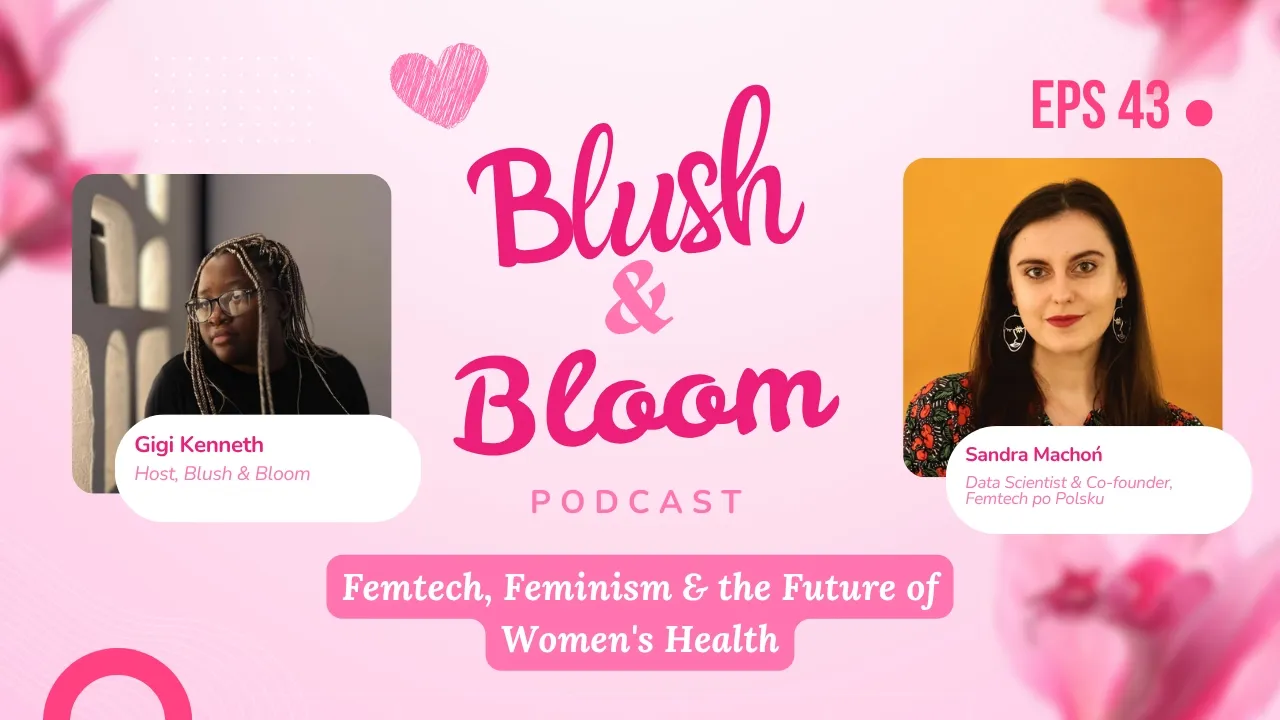
The gender data gap in women's health is one of those problems that hides in plain sight: for decades, medicine has been studied, measured, and funded around male bodies, leaving women's health under-researched and under-served. On this week's Blush & Bloom, Gigi Kenneth sits down with Sandra Machoń, a data scientist with a background in psychology and neuroscience and a co-founder of Femtech po Polsku, to talk about what it takes to close that gap.
Sandra's path runs from academia through data science and into femtech, with a stop at the women's health company Elvie along the way. It makes her unusually well placed to answer a deceptively simple question: if we want technology that actually serves women, what data do we need, who gets to hold it, and what are we still failing to measure?
In This Episode, We Cover:
- How Sandra moved from psychology and neuroscience into data science and femtech
- What the gender data gap is, and why it costs women better care
- The femtech scene emerging in Poland, and the community behind Femtech po Polsku
- Women's health data and privacy, and why protection has to be built in
- The overlooked role of environment and lifestyle in women's health
- Building a data science career in the age of AI
What is the gender data gap in women's health?
The gender data gap is the systematic under-representation of women in medical and scientific data. Research has historically defaulted to male bodies, so conditions that affect women, from hormonal health to menopause, are studied less and understood less. As Sandra puts it, better women's health starts with better data about women in the first place.
Why is femtech growing in Poland?
Poland's femtech scene is young but accelerating, and communities like Femtech po Polsku are helping it find its feet by connecting founders, researchers, and clinicians. Sandra co-founded the initiative to build that network locally and, in time, across the region, so women's health tech has somewhere to grow.
How should femtech handle women's health data?
Women's health data is among the most sensitive information a person can share, so trust has to come first. Sandra's position is that protection cannot be left to users to police; it has to be built into products and, ideally, mandated by regulation like GDPR. In femtech, privacy isn't a feature, it's the foundation.
The environment's hidden role in women's health
One of the episode's most interesting threads is everything women's health research still overlooks. We are finally starting to include hormone cycles and sex-specific physiology, but environment and lifestyle barely get a look in, from why women in Japan report fewer menopause symptoms to how air pollution may affect cycle length. "Why are we not asking those questions?" Sandra asks. It's a small sentence with a long research agenda behind it.
Building a data science career in the age of AI
Sandra is candid about how quickly the field is changing and what still matters underneath the AI hype. Her throughline is refreshingly human. "You don't have to have anything figured out when you're 15. Or twenty or thirty. Life is long, and you can still change things around," she says, and coming from someone who switched fields and built something new, it lands as evidence rather than a platitude.
FAQ
What is femtech? Femtech is technology built for women's health, spanning far more than period trackers, from AI-supported screening to menopause care, mental health, and reproductive health.
Who is Sandra Machoń? Sandra Machoń is a data scientist with a psychology and neuroscience background, a co-founder of Femtech po Polsku, and a former team member at the women's health company Elvie.
What is Femtech po Polsku? Femtech po Polsku is a community building the femtech ecosystem in Poland, connecting founders and experts working on women's health technology.
Why does women's health data privacy matter so much? Because reproductive and health data is deeply personal and easily misused; strong, mandated protection keeps it from being turned against the people who share it.
What book does Sandra recommend? The Menopause Manifesto by Dr. Jen Gunter, a science-forward guide to understanding menopause.
Listen to the full episode
Hear the full conversation on Spotify or Apple Podcasts, and explore more guests on the Blush & Bloom podcast hub. For a related listen, see our earlier episode on building femtech.
Connect with Sandra on LinkedIn, at sandramachon.com, and through Femtech po Polsku.
← Back to The Journal