Medical AI and the Gaps in Women's Health Research | Blush & Bloom Podcast | Ep. 35
Medical AI and women's health research take center stage as Dr. Oshin Behl explains what real medical AI is, why women are underrepresented in trials, and where AI helps.
Women's health research is still catching up. Despite a wave of new tools and apps, women remain underrepresented in clinical trials, and much of the data needed to build better diagnostics simply does not exist yet. When the underlying data has gaps, so does everything built on top of it, including artificial intelligence.
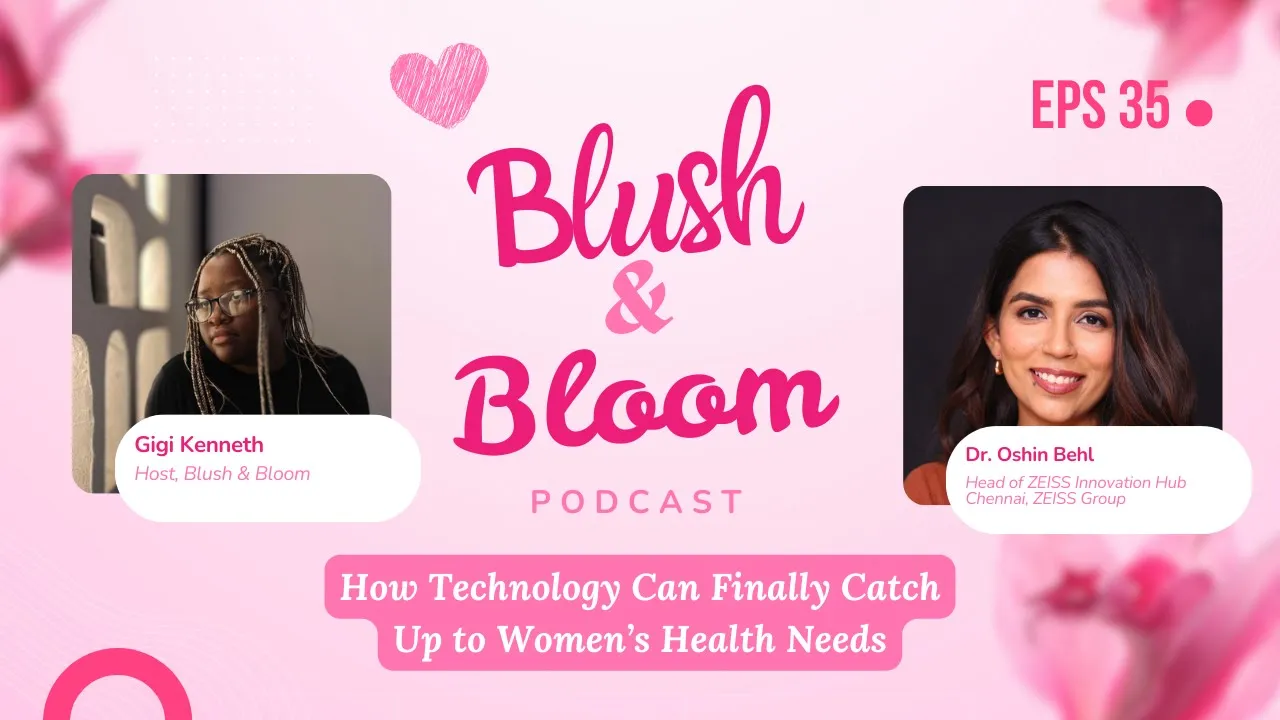
In this episode of Blush & Bloom, host Gigi Kenneth talks with Dr. Oshin Behl, a clinician-scientist with an MBA who works as an Innovation Manager at the technology company Carl Zeiss, where she evaluates deep tech and translates cutting-edge science into commercially viable products. She began her career as a medical doctor in India, moved into research and a clinical postdoc in Germany, and now sits at the meeting point of medicine, science, and business.
Together they dig into the biggest gaps in women's health research, what medical AI actually is (and is not), the difference between precision and personalized medicine, and why Dr. Oshin believes clinical researchers need to stop waiting for permission to do this work.
In This Episode, We Cover:
- Why women are still underrepresented in clinical trials and research data
- What actually counts as medical AI, versus tools that just improve workflow
- Where AI can genuinely help in diagnostics and treatment planning, and where to be cautious
- The difference between precision medicine and personalized medicine
- How health tech can reach the masses instead of staying in the premium bracket
- Why rising infertility rates are a research frontier worth watching
- How startups and large companies can collaborate without copying each other
🔬 What Are the Biggest Gaps in Women's Health Research?
The biggest gaps are not only technological, they are in the systems and processes behind the science. Dr. Oshin argues that the field has overcompensated by rushing into technology innovation before collecting the basic data on what female patients actually need. Without that data, better diagnostics and fairer trials cannot follow.
She points to clinical trials that still include too few female participants, and to diagnostics that rarely account for how a disease presents differently in women. Machine learning could help close these gaps, but only once the underlying research exists to train it on.
"Till we don't collect the data on what are the actual unmet needs for female patients, we will not be able to address them."
⚙️ What Actually Counts as Medical AI?
A scribe or a translator is not medical AI, in Dr. Oshin's view. Those are process improvers. They help doctors document faster and see more patients, which has its place, but they do not create direct clinical impact. Real medical AI has to change the clinical workflow itself, through diagnostics or treatment.
She is direct about the misconception. Tools that speed up documentation feed a "see more patients, make more money" logic that has already bled into healthcare. Medical AI, she argues, should do things that are not humanly possible: spotting biomarkers invisible to the eye, detecting patterns faster than any clinician could, and improving both diagnosis and treatment planning.
🤖 Where Can AI Help, and Where Should We Be Cautious?
The caution and the opportunity are two sides of the same problem. Because many clinicians do not fully understand AI, they tend to either overestimate it, making decisions not grounded in fact, or underestimate it, limiting it to admin tasks. AI also carries bias, and where women's health data is thin, there is little for a model to build on.
Dr. Oshin sees the real opportunity in access. AI's biggest advantage is making things possible that were not possible before. She would rather see it deployed in low-resource settings, where clinicians lack tools, than concentrated in the best-equipped hospitals that already have what they need. Gigi raises the flip side from a Nigerian context: people who lack a smartphone or even reliable electricity cannot benefit from tools built on the assumption that both exist.
💡 Precision Medicine or Personalized Medicine?
They are not the same thing, and the difference matters. Precision medicine studies whole populations to make diagnosis and treatment as accurate as possible using more data. Personalized medicine works at the individual level, linking a person's own factors to their treatment recommendation. Dr. Oshin says personalized medicine is not a buzzword or a fad, but the genuine next step in care.
Her caution: a lot of people are "doing precision medicine and calling it personalized medicine." Patients notice when someone of a different age, ethnicity, or reproductive background gets the same recommendation they did, and they lose faith. Anyone building in this space, whether for chronic disease, menstrual health, or preventive tracking, should be clear on what the individual genuinely contributes to the recommendation.
🌍 How Can Health Tech Reach the Masses?
By becoming faster, less invasive, and more affordable. Dr. Oshin, who works in Germany surrounded by advanced technology, notes that many solutions are over-engineered and priced into a premium bracket that most of the world cannot reach. Reaching the masses means designing for markets with large populations and limited budgets, not just tier-one cities.
It also means education and screening, not only treatment. She describes towns in India where even wealthy people miss life-saving diagnoses simply because health education never reached them. For women especially, many populations lack access to basic health education, screening, and diagnostics. As she puts it, you cannot seek treatment for something if you never knew to look for it in the first place.
🌱 Why Infertility Research Is a Frontier
Over roughly the last decade, both infertility and its diagnosis have been rising in women, yet most cases are still labeled idiopathic, or unexplained. In men, causes like sperm count or motility are relatively straightforward to identify. In women, the system is far less understood, which leaves many hearing only that the cause is unknown.
Dr. Oshin finds this frustrating and, at the same time, energizing. Reproduction is fundamental, and yet the understanding around it is thin. That gap is now drawing more research and more solutions, including cycle-tracking approaches that help women work with their own hormones. She expects the field to grow substantially in the coming years.
🤝 How Can Startups and Corporates Work Together?
By playing to their different strengths instead of imitating each other. Large companies can put more capital and time behind a problem and iterate carefully. Startups are lean and move fast. The magic happens, Dr. Oshin says, when a big company keeps autonomous, flexible divisions that can "speak the same language" as a startup, so the two collaborate rather than compete.
That translation role between industry and startups is exactly where she sits. The startup brings speed and a fresh technology, the larger player brings reach and refinement, and in the end the patient benefits when a good solution actually makes it to market.
FAQ
What does Dr. Oshin Behl count as medical AI? Only AI that changes the clinical workflow through diagnostics or treatment. Scribes and medical translators are process improvers that save time, but she does not count them as medical AI because they lack direct patient impact.
What is the difference between precision and personalized medicine? Precision medicine studies whole populations to make diagnosis and treatment more accurate using more data. Personalized medicine works at the individual level, factoring in a person's own characteristics. Many products labeled personalized are really precision medicine.
Why are women underrepresented in clinical research? The data on women's unmet needs has not been collected at scale, and clinical trials have historically included too few female participants. Dr. Oshin urges clinical researchers to take ownership rather than wait for mandates.
Where can AI make the biggest difference in healthcare? In low-resource settings that lack tools and specialists, and in diagnostics and treatment planning, where AI can detect patterns and biomarkers beyond human capability, rather than only in already well-equipped hospitals.
What advice does Dr. Oshin have for women? Knowledge is power. She encourages women to educate themselves using credible resources, question their clinicians, and push for more testing when an answer like "just lose weight and stress less" does not feel right.
💬 Final Thoughts
This conversation is a reminder that better tools alone will not fix women's health. The data has to exist, the AI has to do something genuinely clinical, and the solutions have to reach the people who need them most. Dr. Oshin's throughline is both practical and hopeful: build for real needs, be honest about what the technology does, and keep saying yes to the work. As she tells the women listening, knowledge is power, and questioning your own care is part of taking it back.
👥 Connect with the Guest
Dr. Oshin Behl: https://www.linkedin.com/in/oshinbehl/
Gigi Kenneth (Host): https://www.linkedin.com/in/gigikenneth
💕 Explore More from Asele
Visit: https://www.asele.tech
Try the Asele app: https://asele.health
Join our WhatsApp community: https://chat.whatsapp.com/F8GY4RV7Bm2CtCfq6TONsV
LinkedIn: https://linkedin.com/company/asele
Spotify: https://open.spotify.com/show/6NEsMfkG3dvl0pYXU40Efi
← Back to The Journal