The Future of Women's Health, Wearables, and Genomics | Blush & Bloom Podcast | Ep. 27
The future of women's health runs on community, wearables, and genomics. Aline Noizet joins Blush & Bloom to unpack what really moves femtech forward.
The future of women's health rarely arrives as a single breakthrough. More often, it is the quiet, patient work of connecting the right people, validating an idea with the women it is meant to serve, and helping a small startup earn the trust of a hospital or a pharma company. That slow, relationship-driven work is exactly where real impact lives.
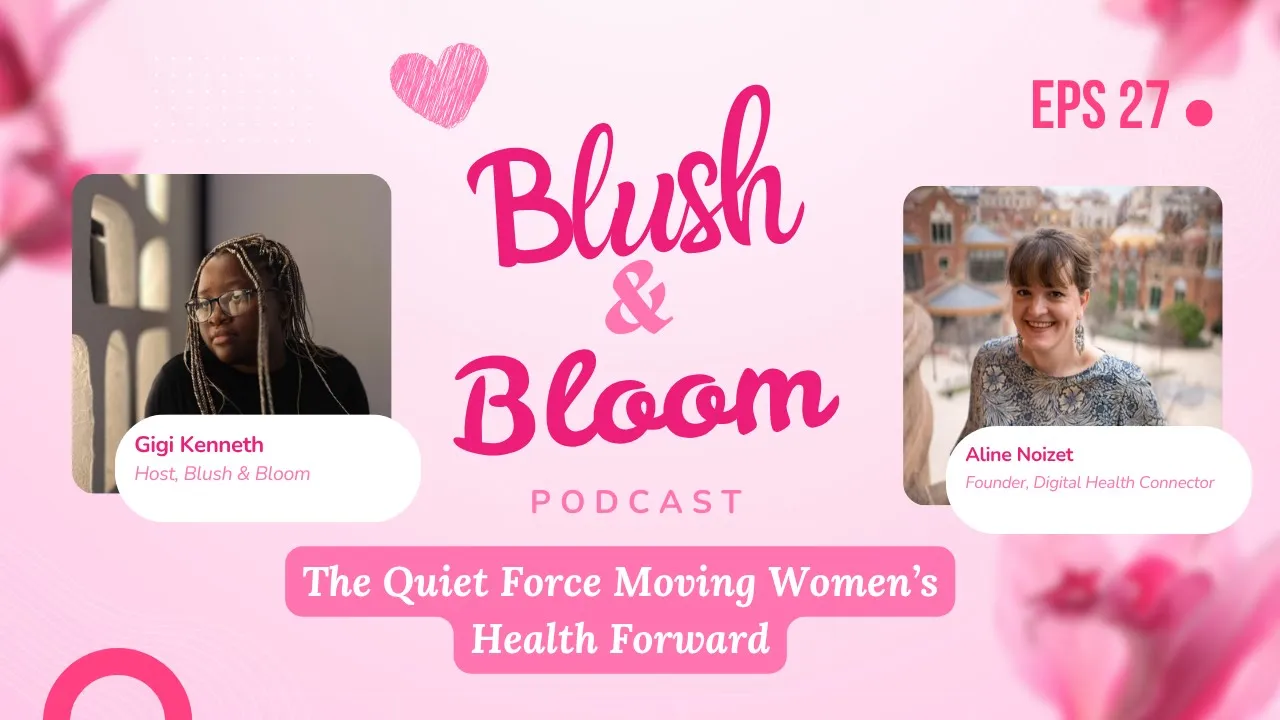
In this episode of Blush & Bloom, host Gigi Kenneth talks with Aline Noizet, who describes herself as a digital health connector and runs Digital Health Connector as an umbrella for the work she does linking startups, doctors, hospitals, pharma, insurers, and investors across the digital health ecosystem.
Together they explore how women's health innovation actually happens, why wearables and genomics are reshaping preventive care, and how founders can navigate healthcare without losing their mission.
In This Episode, We Cover:
- How Aline stumbled into digital health and never looked back
- What selling truck spare parts taught her about listening and adaptability
- The trends shaping the next wave of femtech, from connected devices to consolidation
- Why clinician adoption is so hard, and how to earn it
- Wearables, the Oura ring, and where personal tracking is heading
- Venture clienting explained, and why pharma partnerships matter for femtech
- Genomics, prevention, and a future where women live longer and with less pain
How Did a Digital Health Connector Get Started?
Aline's path into digital health was not planned. While taking her master's in Barcelona, she met the founder of a health startup at a student event who happened to be looking for a French speaker. She almost turned the sales role down, then said yes.
"I'm very fond of the way it started, actually. I think it's really like exactly like a love story, something that came up out of nowhere that I didn't expect."
Her first day, on her birthday, was an event in Madrid with around 100 doctors and nurses talking about blogging and tweeting. She loved it from day one, and more than a decade later she is still in the space.
🚚 What Trucks and Spare Parts Taught Her About Health Tech
Before health tech, Aline supported after-sales for trucks and spare parts in the UK, fielding calls from customers across Manchester, Scotland, and Wales. It sounds unrelated, but it shaped how she works today.
Struggling to understand what callers needed, she asked the engineering team for exploded diagrams of each truck, numbered every part, and sent the document to customers so they could simply point to a number. A cool solution to a concrete problem. She also learned adaptability, teamwork across many moving pieces, and that customer service does not end when the sale does.
🌐 What Trends Are Shaping the Next Wave of Women's Health?
The next wave of femtech will be more connected. Aline expects solutions that analyze your own data and offer recommendations rather than relying on manual entry, more devices moving from consumer gadgets toward medical-grade tools, and fragmented apps consolidating into fewer, more complete products.
She points out that women today can end up juggling four or five different health apps on one phone. Bringing those together, she says, would serve women better, and it will likely drive mergers and partnerships as companies join efforts to tackle the same problems.
💍 Wearables, the Oura Ring, and Personal Tracking
Aline tracks her cycle across a few apps, but the Oura ring is the one that has stuck because it learns from her data automatically instead of asking her to log everything by hand. Asked how a ring differs from a smartwatch, her answer is refreshingly plain: they collect more or less the same thing, so it comes down to preference. She simply forgets the ring is there. She is also excited about newer wearables, including an earring designed for tracking.
🩺 Why Is Clinician Adoption So Hard?
Because many solutions reach the market without meeting what the end user actually needs. Clinicians are already overloaded, so they can see new tools as a threat that adds work to their day. The fix is to co-create with healthcare professionals from day one and to sit down with them and explain the benefits, so the tool is understood as support rather than more work.
This is where a lot of promising products stall. Gigi and Aline discuss how women have innovated better tools, including alternatives to the speculum, only to find them hard to spread because clinicians are not always motivated to learn something new for a problem, women's pain, that has been overlooked for too long.
🔬 What Separates Founders Who Succeed From Those Who Don't?
Understanding the customer and the unmet need, then validating early. Founders should know who feels the pain and who actually pays for the solution, because in femtech the woman may have the pain while an insurer or hospital foots the bill. They also need to map the ecosystem, understand hospital workflows and regulation, and bring scientific evidence.
Aline highlights the value of clinical validation and real-world evidence, citing a UK team developing an at-home test that could replace the speculum, mailed back and returned with results on your phone, backed by a published paper. Her practical advice to founders: get a clear value proposition, build a realistic roadmap that budgets for regulation, delay taking investor money as long as possible by bootstrapping and applying for grants, and lean on communities.
🤝 What Is Venture Clienting, and Why Does It Matter for Femtech?
Venture clienting is when a large organization, often a pharma company, hospital, or insurer, becomes your paying client rather than only an investor. For a startup that can mean big early contracts, access to real-world use cases and data for validation, and help distributing your product through partners who already reach clinicians.
Aline notes strong pharma interest in women's health across different verticals, with several major companies focused on areas like endometriosis, menopause, and various cancers. As pharma moves toward a more holistic view of the patient beyond just providing a drug, a femtech solution can help bridge a gap or support the wider patient journey.
🧬 Genomics, Prevention, and Living Longer Without Pain
What excites Aline most is personalized medicine and genomics. She recently did a genomic test through her hospital in Spain and describes how the results can feed into a tailored prevention program. For women's health, she believes this means being more empowered and knowing ourselves better, especially given how many gaps still exist around conditions like menopause.
"We know that women are living longer, but they're also living with more pain."
Her hope is that genomics and digital therapeutics together can help identify the causes of that pain and address symptoms, so women live not just longer but better and healthier.
🤖 What About AI in Healthcare?
Aline sees AI as a support, not a replacement. It is already making a real difference in digital health by triaging and organizing information, and AI agents can take workload off clinicians and patients alike. Her framing is grounded: AI should help healthcare professionals and patients be more efficient and know more, making things easier rather than removing the human.
FAQ
Who is Aline Noizet? Aline Noizet is a digital health connector and the founder of Digital Health Connector, a company she runs as an umbrella for connecting startups with the wider digital health ecosystem, including hospitals, pharma, insurers, and investors. Her mission is helping innovative solutions reach the people who need them most.
What is venture clienting? Venture clienting is when a corporate, often a pharma company, hospital, or insurer, becomes a startup's paying client instead of only an investor. It gives startups revenue, real-world data to validate their product, and distribution help through partners who already reach clinicians.
What trends will shape the future of women's health? More connected solutions that analyze your own data, a shift from consumer gadgets toward medical-grade devices, consolidation of fragmented apps into more complete products, and growing interest from pharma. Genomics and personalized medicine are also expected to power prevention.
Why is it hard for new medical tools to reach hospitals? Clinicians are already overloaded and can view new tools as extra work. Many products also launch without meeting the real needs of their end users. Co-creating with healthcare professionals early and clearly showing the benefits helps adoption.
What advice does Aline give early-stage femtech founders? Understand your customer and the unmet need, know who actually pays, validate hypotheses early, map the ecosystem and regulation, back your solution with scientific evidence, delay investor money by bootstrapping and applying for grants, and join communities.
💬 Final Thoughts
The through-line of this conversation is that women's health moves forward when people listen first and build together. Wearables, genomics, and AI are powerful, but they matter most when they are grounded in what women and clinicians actually need. As Aline puts it, women need to be in the driver's seat, sharing how they feel and what hurts, because that is how healthcare advances for all of us.
👥 Connect with the Guest
Aline Noizet: https://www.linkedin.com/in/aline-noizet-84212622/
Gigi Kenneth (Host): https://www.linkedin.com/in/gigikenneth
💕 Explore More from Asele
Visit: https://www.asele.tech
Try the Asele app: https://asele.health
Join our WhatsApp community: https://chat.whatsapp.com/F8GY4RV7Bm2CtCfq6TONsV
LinkedIn: https://linkedin.com/company/asele
Spotify: https://open.spotify.com/show/6NEsMfkG3dvl0pYXU40Efi
← Back to The Journal