What Economic Violence Does to Women's Health | Blush & Bloom Podcast | Ep. 24
Economist Claudia Segre joins Blush & Bloom to explain economic violence against women, how financial control harms health, and why financial literacy protects both.
Economic violence is one of the least discussed forms of abuse, yet it quietly shapes the physical and mental health of millions of women. When money becomes a tool of control, the damage rarely stays in a bank account. It shows up as anxiety, depression, delayed care, and years of lost independence.
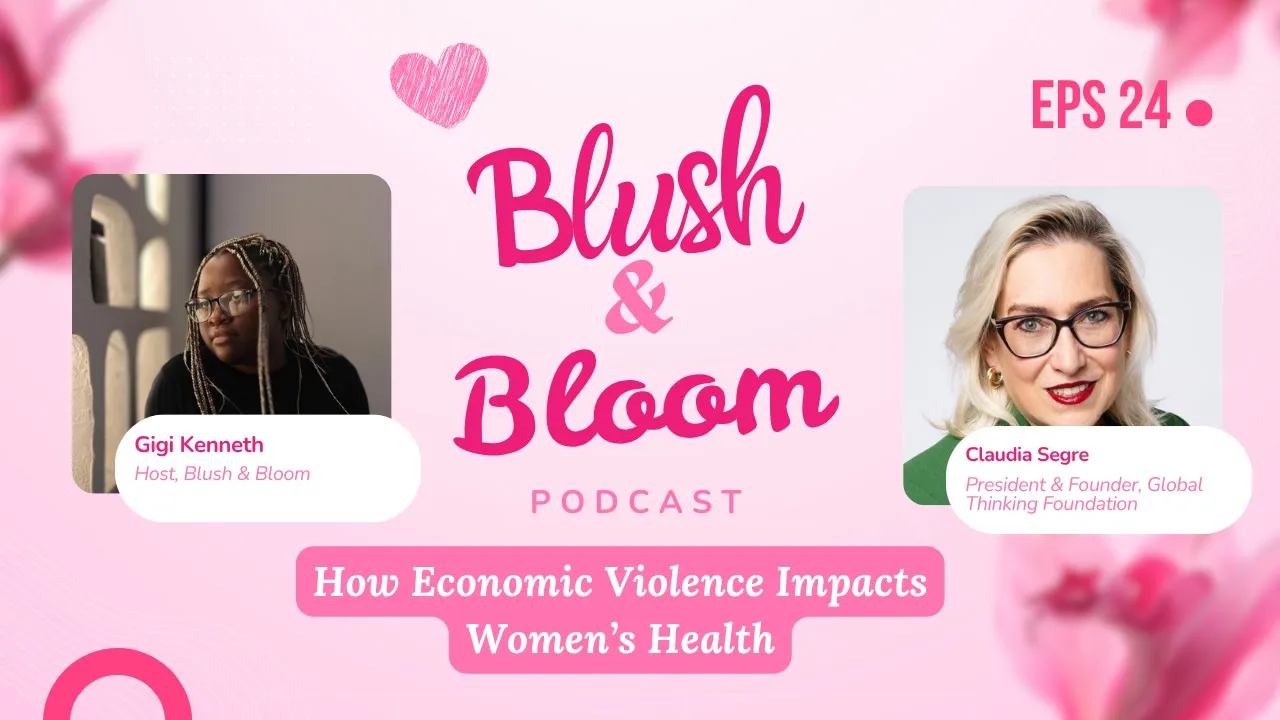
In this episode of Blush & Bloom, host Gigi Kenneth talks with Claudia Segre, an economist and activist who founded the Global Thinking Foundation in 2016 after more than 35 years in international finance. Through the foundation, she works to empower women and girls with financial and digital literacy so they can prevent economic violence and financial abuse.
Together they trace the line between money and wellbeing, from what economic abuse actually looks like inside a relationship to how femtech, fair policy, and one simple habit can help women rebuild their autonomy.
In This Episode, We Cover:
- What economic violence is and how it fits alongside physical, sexual, and psychological abuse
- How financial control quietly moves from care to coercion inside a relationship
- The mental and physical health toll of financial stress
- Why financial literacy is a foundation for resilience and autonomy
- Taking women's stories to the G7, W7, the OECD, and the United Nations
- How femtech and longevity tech connect financial health to women's health
- One policy Claudia would change tomorrow, and one step any woman can take today
What Is Economic Violence?
Economic violence is the use of money to control another person, and Claudia roots it in the Istanbul Convention, the international treaty that names four types of gender violence: economic, psychological, sexual, and physical. In a relationship it can look like controlling the money, denying access to it, or forcing debt onto a partner, keeping one person financially dependent on the other.
She describes how that control tends to escalate. What can start as shared decisions slowly becomes an asymmetry between two people, then an exclusion from financial decisions altogether.
"We moved to a care to control."
Once someone loses the ability to make choices, they also lose access to things that protect their future, like insurance or a retirement plan. Claudia notes that in Italy, 46 percent of women have no health insurance policy of their own.
How Does Financial Control Affect Women's Health?
Financial stress does not stay financial. Claudia is direct that money worries are tied straight to mental and physical health, which is why she frames financial health as something to protect as a whole, not a separate spreadsheet problem.
She points to two patterns she sees often. The first is behavioral: people in distress reach for what looks like an easy way out, from compulsive shopping and speculative trading to gaming and gambling, and that search for quick money can harden into addiction. The second is the long shadow of signing a guarantee or contract without understanding it, which can leave a lasting question mark over someone's economic future and even threaten their standing in a new job or career.
Why Financial Literacy Is a Form of Self-Care
Claudia's core argument is that building financial skills is inseparable from building freedom. When women gain literacy and autonomy, she says, the benefits ripple outward to families and communities, but they start with the individual.
"Build your confidence, it builds your freedom."
Her first, practical step is small on purpose: get familiar with your own budget, personal and household. She cites that more than a third of women are not used to setting a budget or a plan for the medium and long term, and that delegating those choices to someone else is exactly where dependence begins. Basic financial education, taken step by step, is how that dependence gets undone.
Taking Women's Stories to the G7 and the UN
Claudia has carried these conversations into global rooms. She helped host young activists at the Women's Seven summit during the Italian G7, working with civil society to connect women's empowerment, labour participation, and reducing the social cost of violence against women and girls. One outcome she highlights is gender certification for companies, a step toward tying corporate responsibility to real wellbeing measures for women workers.
The foundation is also an affiliate member of the OECD's International Network for Financial Education and takes part in working groups linked to the IMF, the World Bank, and the UN Commission on the Status of Women. Her reason for all of it is simple: the only way to improve is to exchange best practices across borders and learn from what works in other countries.
Can Technology Actually Protect Women?
Yes, when it is designed to. Claudia points to two fields beyond traditional fintech: femtech and longevity tech. Digital tools for menstrual health, menopause, fertility, and wellbeing can reduce medical costs and sick days, but she argues their real power is economic when they also open access to insurance and workplace welfare.
For Claudia, femtech is not only about tracking cycles. As she puts it, when she talks about femtech she is talking about acting on economic equity for women, because a woman who is not financially stable cannot afford the very tools meant to care for her. She also welcomes the United Nations department for financial health established in October 2024 and led by Queen Máxima, seeing a shared way to measure financial health as a real step toward better rules and inclusion.
The One Policy, and the One Step
Asked what law she would change tomorrow, Claudia's answer is concrete: give everybody their own personal bank account. Sharing an account with a partner is fine, she says, but having your own is the most important rule of safety, a way to take responsibility for yourself and to respect yourself. Both accounts can coexist, but the personal one is what makes the difference for your future.
And for a young woman who does not see herself as a financial expert yet, her one step is a mindset shift: stop treating money as a threat or as something to hand off to someone else, and start seeing it as the line between financial freedom and dependence.
FAQ
What is economic violence? Economic violence is a form of abuse where one person uses money to control another, through tactics like controlling or denying access to money or forcing debt. The Istanbul Convention lists it alongside physical, sexual, and psychological violence.
How does financial abuse affect health? Financial stress is directly linked to mental and physical health. It can drive anxiety and depression, push people toward behavioral addictions like gambling, and cut off access to protections such as health insurance and retirement planning.
What is the first step to financial independence? Start with your own budget, personal and household, and build basic financial literacy from there. Claudia frames confidence and freedom as things you build step by step, rather than skills you delegate to someone else.
Why should every woman have her own bank account? A personal account, even alongside a joint one, keeps a woman in control of her own money and decisions. Claudia calls it the most important rule of safety for protecting your financial future.
How is femtech connected to financial health? Femtech tools can lower medical costs and support women in the workforce, but they only help women who can afford them. Claudia frames femtech as a matter of economic equity, not just cycle tracking.
💬 Final Thoughts
Economic violence thrives in silence, and this conversation is a push to name it. When money is used as control, health suffers, and when women build financial literacy and autonomy, they protect far more than their finances. Claudia's message is quietly radical: taking ownership of your money is a form of self-care, and a personal bank account can be the start of a personal future.
👥 Connect with the Guest
Claudia Segre: https://www.linkedin.com/in/claudiasegre/
Gigi Kenneth (Host): https://www.linkedin.com/in/gigikenneth
💕 Explore More from Asele
Visit: https://www.asele.tech
Try the Asele app: https://asele.health
Join our WhatsApp community: https://chat.whatsapp.com/F8GY4RV7Bm2CtCfq6TONsV
LinkedIn: https://linkedin.com/company/asele
Spotify: https://open.spotify.com/show/6NEsMfkG3dvl0pYXU40Efi
← Back to The Journal