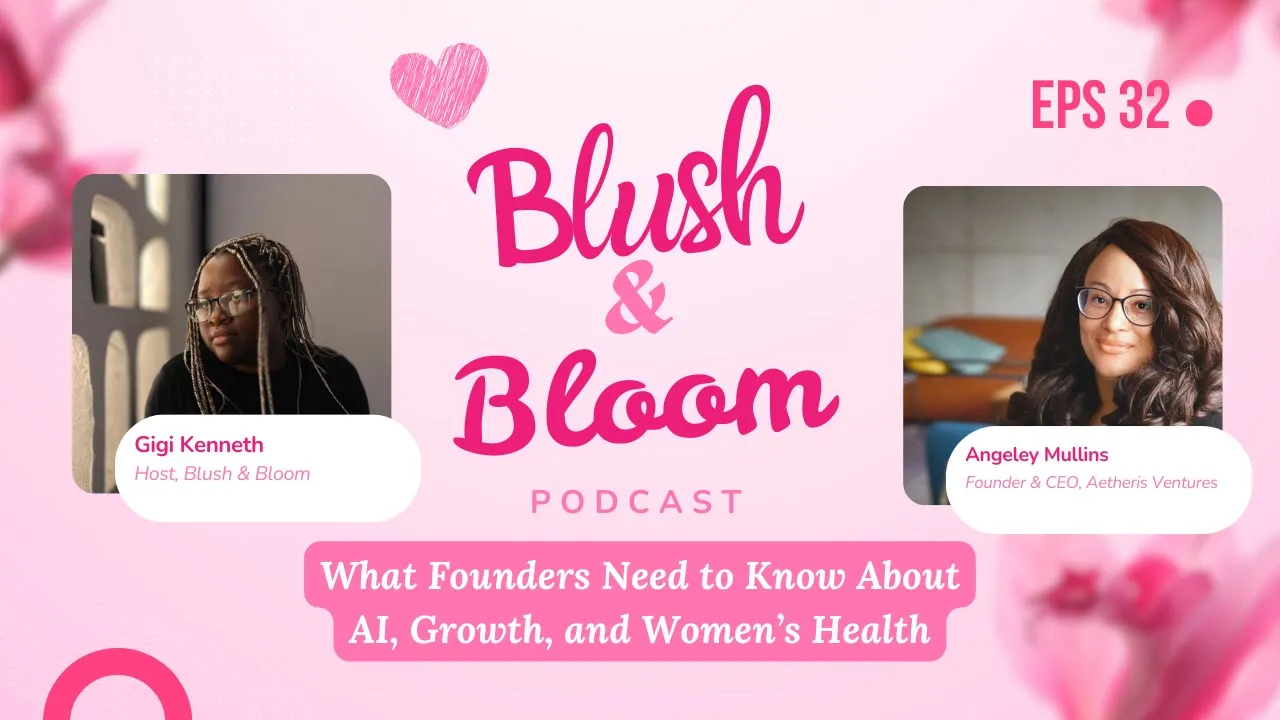
Building and Leading in an AI World, With Angeley Mullins | Blush & Bloom Podcast | Ep. 32
How to build and lead in an AI world: Angeley Mullins on growth, GTM, founder-led branding, critical thinking, and women's health innovation.
AI is reshaping how careers are built, how companies grow, and how founders reach the market. Layoffs make headlines every week, entry level roles are shrinking, and every tool now promises to write, design, or code for you. So what actually keeps a person, or a company, valuable in a world where the cost of producing content and features is racing toward zero?
In this episode of Blush & Bloom, host Gigi Kenneth talks with Angeley Mullins, founder and CEO of Aetheris Ventures, a go-to-market advisory firm that also does angel investing and leadership mentorship for executives and CEOs. Before founding Aetheris, Angeley scaled seven companies across big tech and scale-ups, including Amazon, Intuit, and GoDaddy, in growth and commercial leadership roles.
Together they explore what it really means to build and lead in the age of AI: why corporate careers are no longer the safe bet, why entry level jobs are disappearing, what founders get wrong about growth, and why critical thinking and founder-led storytelling are becoming the skills that matter most, especially for women building in femtech.
In This Episode, We Cover:
- Why the corporate career track no longer counts as the "safe" choice
- How AI is reshaping the job market and why entry level roles are disappearing
- The mistake companies make when they cut their content teams
- What a go-to-market advisor actually does, and why standardized playbooks fail
- How to build teams that work together, not just rooms full of smart people
- Why founder-led storytelling is becoming an essential differentiator
- The femtech founders and companies Angeley is watching right now
- Why critical thinking, not any AI tool, is the number one future skill
🚪 Why is a corporate career no longer "safe"?
Because layoffs are now a constant, not an exception. Angeley points to Amazon cutting tens of thousands of roles and to broader warnings about AI driven job loss. The takeaway is not panic, it is ownership: understand your personal value proposition, how you differentiate, and how you get ahead of the curve rather than assuming a job title will protect you.
"If anyone thinks that a traditional corporate career is going to be the safe and cozy spot, think again."
She frames founder life honestly too. It is a roller coaster where one day you feel on top of the mountain and the next you are questioning everything. The trade is that the work is yours, built to stand the test of time.
🤖 What jobs is AI actually changing?
AI is already absorbing repetitive, entry level tasks: basic contracts a paralegal might draft, entry level accounting, entry level content writing. Tools like ChatGPT, Perplexity, and Claude can handle the first pass, and new video and design tools are pressing on those fields too. That is why, Angeley notes, companies increasingly reach for a senior who knows what "good" looks like over a junior.
But she draws a firm line around one decision: cutting content teams. She calls it a big mistake. Today's models are, in her words, advanced web scraping tools, so they surface the content that humans have already published. Cut the people creating it and there is less real signal for the machines, and audiences, to find.
🛠️ Canva Code, Lovable, and the race to zero
Angeley walks through how fast low-code and no-code tools are moving, from Canva Code, which turns a prompt into interactive experiences you can embed, to Lovable, where you can spin up a product from a conversation. Her point is not the tools themselves but the economics behind them.
"If the cost of producing a product or the cost of producing a feature goes down to zero, then it's no longer the old system of selling software."
When features are cheap to build and easy to copy, "my features are better than your features" stops being a strategy. Something more human has to carry the value.
📈 What does a go-to-market advisor actually do?
At its core, go-to-market answers three questions: how do you acquire a client, how do you keep them, and how do you grow. Angeley helps founders and CEOs build growth engines around those questions, and she is blunt that there is no single playbook that works for every business.
"If all these playbooks worked, then everybody would have downloaded it and used it, and everybody's company would have been successful."
Instead of copying the hot LinkedIn playbook a friend recommended, she pushes founders to use critical thinking and real experience to find the strategy that fits their specific business and situation. She adds that building great teams is a lost art. Throwing the best product, sales, and marketing people into a room does not create results if they cannot actually work together, and few leaders focus on team dynamics anymore.
💬 Why does founder-led branding matter so much now?
Because when AI generated content is everywhere and effectively free, authentic human stories become the scarce, valuable thing. Angeley calls founder-led branding one of the single most important differentiators over the next five years, and encourages founders to share not just the product but the real journey: the investor conversations, the wins, the hard parts.
She points to founders doing this well, and to a wave of women building serious companies in health. Among those she highlights: Ouli, a device for recovery after cesarean sections; Beeva AI, using AI to analyze skin for people with melanin-rich skin; and Ivee, a platform helping mothers return to the workforce, whose founder documents day-in-the-life founder content that audiences love.
For anyone who would rather stay private, her advice is direct. Get out of your comfort zone, because you never know what opportunities follow. She keeps coming back to the first rule of sales: if you don't ask, the answer is always no. And a founder's number one job, she argues, is not product. It is sales: selling your vision, your company, your investors, and yourself.
🧠 Is AI making us worse at thinking?
It can, if we let it think for us. Angeley's concern is dependency. She compares it to Google Maps: once you stop navigating yourself, you lose the instinct. The same is happening as people ask AI to do their reasoning instead of gut checking it.
"Think through the problem for yourself, use your brain, and then use AI to gut check or to further investigate. But a lot of people are not doing that."
Her prescription, especially for Gen Z and Gen Alpha who are growing up with these tools, is counterintuitive: limit your AI time. Pick the top few things you want to master, put in the real reps without AI, and let the tool handle the rest. You cannot master a craft while outsourcing the part that builds the skill. Critical thinking, she says, will be the number one skill precisely because everything else is getting easier.
On women's health specifically, Angeley is hopeful that more attention and better data will push science to finally study women's bodies properly, an area long overshadowed by research centered on men, while flagging that genetic and ethical questions will need real care.
FAQ
Who is Angeley Mullins? Angeley Mullins is the founder and CEO of Aetheris Ventures, a go-to-market advisory firm that also does angel investing and leadership mentorship. She previously held growth and commercial leadership roles and scaled seven companies across big tech and scale-ups, including Amazon, Intuit, and GoDaddy.
What is go-to-market (GTM) strategy? Go-to-market strategy is how a company acquires clients, keeps them, and grows them, spanning marketing, sales, and customer success. Angeley emphasizes there is no universal playbook: the right GTM strategy depends on each business's product-market fit, pricing, and situation.
Why shouldn't companies cut their content teams because of AI? Because current AI models largely surface content that humans have already created. If companies stop producing genuine human content, there is less real material for both audiences and AI tools to find, and AI-only output is often easy to spot and less trusted.
What is founder-led branding and why does it matter? Founder-led branding is when a founder shares their authentic story and journey publicly, not just their product. As AI-generated content becomes abundant and cheap, authentic human stories stand out, which is why Angeley sees it as a key differentiator over the next five years.
What is the most important skill in the age of AI? Angeley argues critical thinking is the number one skill. As AI tools make tasks easier and reliance on them grows, the ability to reason through problems yourself, then use AI to gut check rather than to think for you, becomes the real edge.
💬 Final Thoughts
"Building in an AI World" is less about the tools and more about what stays human. When features are cheap and content is everywhere, the durable advantages are the ones AI cannot fake: real experience, critical thinking, teams that work, and founders willing to tell their own story. For women building in femtech, that is not a consolation prize. It is the whole game, and, as Angeley shows, it is already being played by founders worth watching.
👥 Connect with the Guest
Angeley Mullins: https://www.linkedin.com/in/angeleymullins/
Gigi Kenneth (Host): https://www.linkedin.com/in/gigikenneth
💕 Explore More from Asele
Visit: https://www.asele.tech
Try the Asele app: https://asele.health
Join our WhatsApp community: https://chat.whatsapp.com/F8GY4RV7Bm2CtCfq6TONsV
LinkedIn: https://linkedin.com/company/asele
Spotify: https://open.spotify.com/show/6NEsMfkG3dvl0pYXU40Efi
← Back to The Journal