Building for Women's Health: Funding, Founders, and Impact | Blush & Bloom Podcast | Ep. 22
Building for women's health is hard. Jill Miranda joins Blush & Bloom to unpack femtech funding gaps, founder burnout, and why women's health is human health.
Building for women's health is one of the most needed and least supported jobs in tech. Founders are asked to fix problems the medical system barely studied, raise money from investors who call the market niche, and hold it all together while the emotional toll quietly adds up.
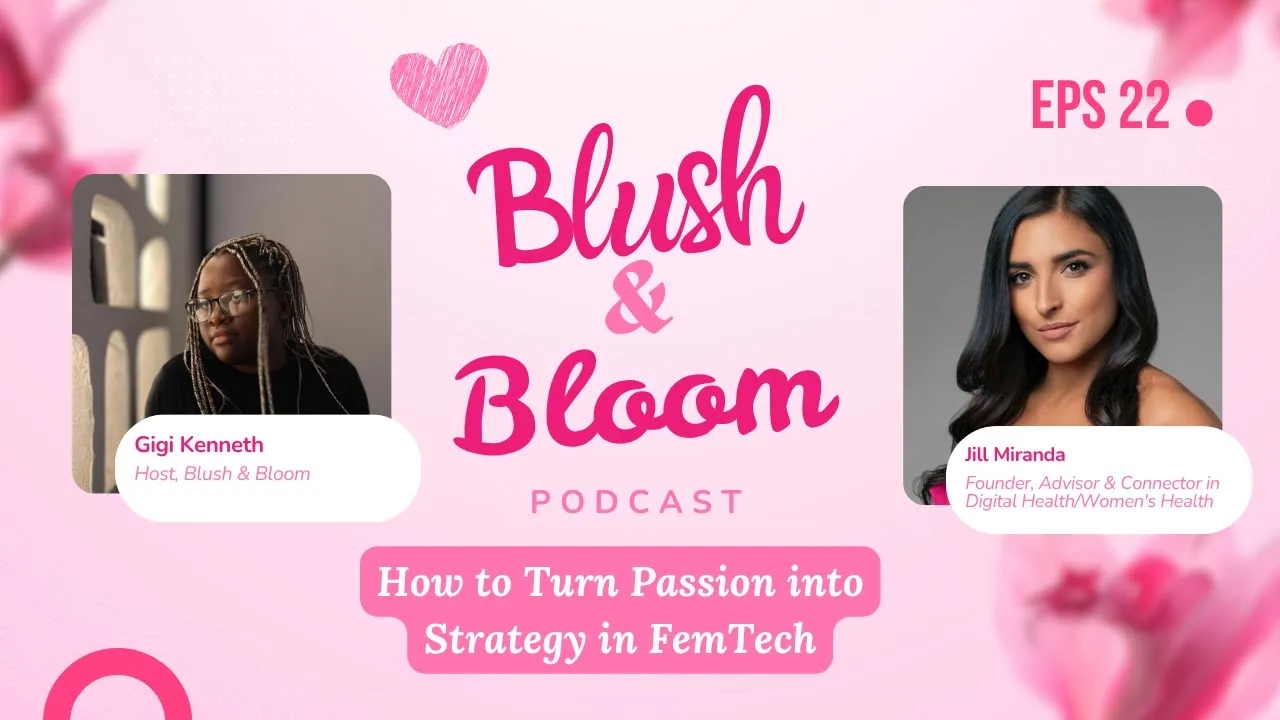
In this episode of Blush & Bloom, host Gigi Kenneth talks with Jill Miranda, a femtech advisor and digital health operator who works with startups building for vulnerable populations, with a particular focus on women's health. Jill is the Managing Partner at Snatch Health, which she co-founded to support early-stage, often first-time, female founders who are usually overlooked by traditional consultants and investors.
Together they get into the hard truths of building in this space: why women's health startups struggle to raise, the costly mistakes early founders make, how commercialization can quietly decide whether an innovation survives, and why caring for yourself is part of the work, not a distraction from it.
In This Episode, We Cover:
- Why women's health startups struggle to raise funding
- The most common and costly mistakes early femtech founders make
- How commercialization can make or break a good idea
- The gender data gap and why so much health research skips women
- What real impact looks like beyond growth metrics
- Why women's health is human health
- How founders can take care of themselves while building for others
Why do women's health startups struggle to raise funding?
Much of the most exciting innovation in women's health sits at the earliest stages, and early stage is exactly where money is hardest to find. Jill describes rooms full of investors who did not take the category seriously, or who only wanted later-stage bets. The result is a wave of promising companies fighting big to stay afloat before they ever get a real shot.
That gap is what pushed Jill from operator to founder and advisor. She saw first-time female founders making expensive mistakes early, with almost no one willing to help them, because there was not much money to be made in helping small companies find their footing.
"Very costly mistakes at the beginning because they don't know what they're doing."
Snatch Health was built to close that gap, pairing real support with a business model that actually works for the founders who need it most.
📉 What is the gender data gap?
The gender data gap is the shortage of medical research done specifically on women's bodies. Jill points out that for most of modern medicine, research defaulted to the male body, male animals, and male participants. Women were not required in clinical trials in the United States until 1993, and even then studies were often mixed rather than focused on women.
She flags her own figures as things to fact check, which is the honest way to talk about a field this under-studied. Her point stands regardless of the exact number: if we have not studied women's bodies, we cannot fully understand or solve women's health problems.
A clear example is heart disease. The warning signs many people picture, chest pain and pain down the left arm, describe how heart attacks often present in men. Women can experience very different symptoms, which means the standard mental model can miss a heart attack in a woman entirely.
💸 How does commercialization make or break innovation?
A good product is not the same as a viable business. Jill argues that many founders build something meaningful and then struggle to commercialize it, and that gap is where a lot of women's health innovation quietly dies. The work that is hardest to measure, like community, events, and trust-building, often has real value that does not show up cleanly on a spreadsheet.
She has written about how the return on investment for events is not linear and not easily quantifiable, which is exactly why so many people skip that work. But skipping the unglamorous parts of building a business is one of the ways promising ideas fail to reach the people who need them.
🩺 What does real impact look like?
For Jill, impact is not just growth charts or funding rounds. It comes down to something basic: can a person actually get the care they need? She points to structural problems worth fixing, from health systems to reimbursement, but keeps returning to the human scale.
She shares the story of a young woman in her early twenties from one of the companies she founded, whose closest hospital was six hours away and whose nearest doctor would not treat women. To get routine care, that woman had to travel for hours. That is the version of impact Jill measures against, and it is a reminder that access, not just innovation, is the real bottleneck.
💗 Why is women's health human health?
Because the diseases that hit women hardest are human diseases, and treating them well is simply good medicine. Jill notes that women carry a disproportionate share of illness, from autoimmune conditions to a majority of Alzheimer's cases, yet still struggle to get care and reimbursement for it.
She makes a sharp point about language. The field has to keep naming women's health explicitly, because when it was folded into general health it got ignored. Naming it is a strategy, not a separation.
"Women's health care is health care. Period. End of story."
🧘🏽♀️ How can founders take care of themselves while building for others?
Female founders often feel that if they do not carry the mission, no one will, and Jill says there is truth to that. But that pressure has a cost. She is candid that the stress of founding affects everything, from appetite to sleep to sex drive, and that too few founders talk about it openly.
Her advice is to normalize the conversation. Find communities that offer real support, name the toll out loud, and make space to recover, so that women building in this space do not feel as alone.
FAQ
Who is Jill Miranda? Jill Miranda is a femtech advisor and digital health operator who works with startups, with a particular focus on women's health and vulnerable populations. She is the Managing Partner at Snatch Health, a company she co-founded to support early-stage female founders.
Why is it hard to raise money for women's health startups? Much of the innovation happens at the earliest stages, where funding is scarcest, and many investors have historically treated the category as niche or only backed later-stage companies. That leaves promising early companies fighting to stay afloat.
What is the gender data gap? It is the lack of medical research conducted specifically on women's bodies. Women were not required in clinical trials in the United States until 1993, so there is far less understanding of how many conditions present and progress in women.
Why do experts say women's health is human health? Because many diseases affect women disproportionately, and caring for them well is simply good medicine. Naming women's health explicitly is a way to make sure it stops being overlooked.
How can founders avoid burnout while building in women's health? By talking honestly about the emotional toll, leaning on supportive communities, and treating self-care as part of the work rather than a luxury.
💬 Final Thoughts
Building for women's health means working against gaps that were not created by the founders trying to fix them, in funding, in research, and in who healthcare was designed for. What comes through in this conversation is that the work is worth it, and that the people doing it deserve support, honesty, and rest as much as the users they serve.
If this episode resonates with you, share it with someone building in women's health, or someone who needs a reminder that their care matters.
👥 Connect with the Guest
Jill Miranda: https://www.linkedin.com/in/jill-miranda/
Gigi Kenneth (Host): https://www.linkedin.com/in/gigikenneth
💕 Explore More from Asele
Visit: https://www.asele.tech
Try the Asele app: https://asele.health
Join our WhatsApp community: https://chat.whatsapp.com/F8GY4RV7Bm2CtCfq6TONsV
LinkedIn: https://linkedin.com/company/asele
Spotify: https://open.spotify.com/show/6NEsMfkG3dvl0pYXU40Efi </content> </invoke>
← Back to The Journal