Sustainable Fertility Care and Plastic-Free Pregnancy Tests | Blush & Bloom Podcast | Ep. 21
Sustainable fertility care meets femtech as Lara Solomon of Hoopsy explains plastic-free pregnancy tests, the hidden waste in diagnostics, and IVF honesty.
Every year, millions of pregnancy and ovulation tests are used once and thrown away. Most are made of hard plastic, held for a few minutes, then sent to landfill where they can take decades to break down. For a product tied to some of the most hopeful and vulnerable moments in a person's life, that is a lot of waste hiding in plain sight.
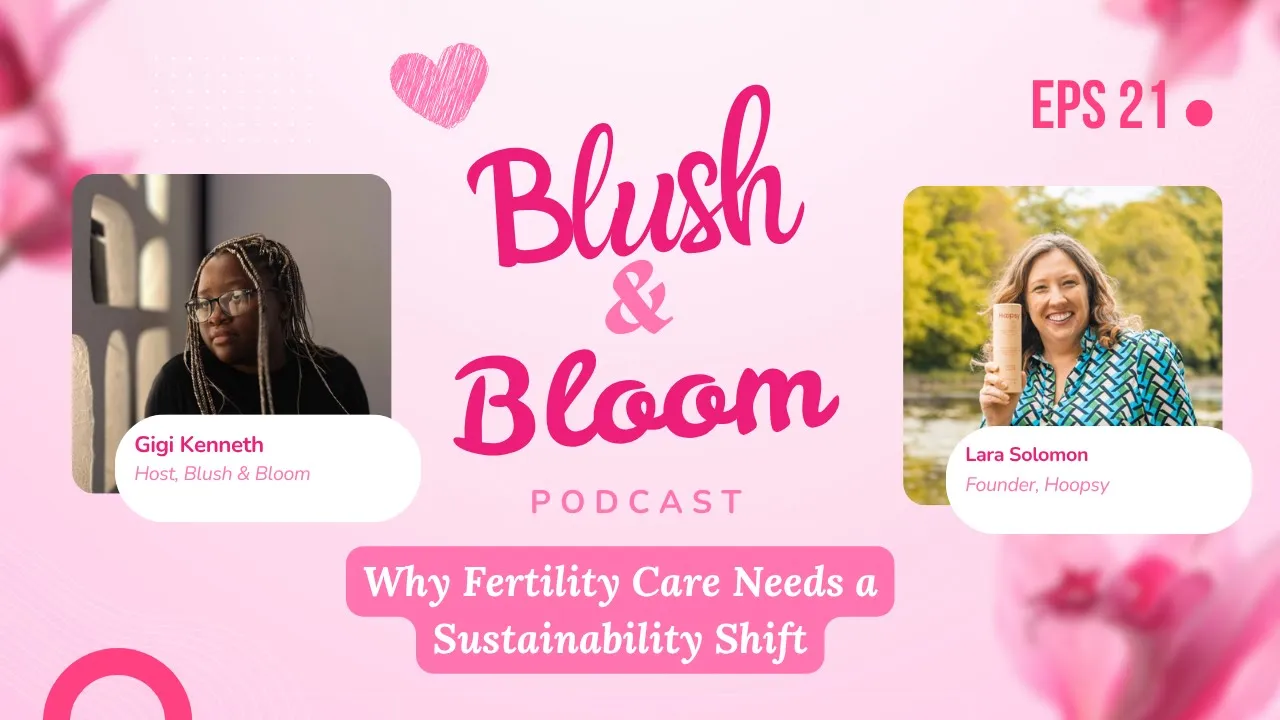
In this episode of Blush & Bloom, host Gigi Kenneth talks with Lara Solomon, founder of Hoopsy, a sustainable health company on a mission to eliminate plastic from diagnostic tests. Her first product is an eco-friendly, largely paper-based pregnancy test, and she is now working toward a fully plastic-free version.
Together they explore how a personal IVF journey turned into a company, why sustainability belongs at the heart of reproductive care, and how honesty about fertility struggles helps other women feel less alone.
In This Episode, We Cover:
- How Lara's IVF experience inspired a plastic-free pregnancy test
- Why sustainability matters in fertility and reproductive care
- The hidden plastic waste behind everyday diagnostic tests
- The challenges of getting FDA approval for a medical product
- How Hoopsy is rethinking product design for both people and the planet
- Why honesty about fertility struggles helps women feel less alone
- Practical, everyday swaps for living more sustainably
🌱 How Did IVF Lead to a Plastic-Free Pregnancy Test?
In 2021, Lara went through IVF while trying to conceive. In online support groups, she kept seeing women share photos of their results, sometimes using ten or fifteen tests in a single cycle. She could not stop thinking about a plastic device used for a few minutes and then discarded.
Her own IVF did not work, but the image stayed with her. She compares it to the plastic straw problem: everyone assumes it is only one, until millions of people make the same small choice.
"I just thought someone needs to do something. Stuff it. Why not me?"
That question became Hoopsy.
Why Does Sustainability Belong in Fertility Care?
Because the waste and the wish are connected. Plastic in landfill breaks down into microplastics that end up in our water, food, and bodies, including in breast milk and in babies before birth. Lara also found that trying for a child made her think harder about the world she would be bringing that child into, which pushed her toward consuming less.
For her, fertility care and sustainability are not two separate concerns. They are the same story told from two sides.
🧪 How Much Plastic Is Really in a Pregnancy Test?
More than most people expect. Midstream tests use a hard plastic case. Even the thin strip tests common in many countries still contain plastic, by Lara's estimate around 40 percent. The amounts can be small in grams, but multiplied across a global market they add up fast.
She points out that a lot of that plastic is there for perception rather than performance, because a solid plastic device is seen as looking more premium than a paper strip that works just as well.
♻️ A Different Design Philosophy: Take Away, Don't Add
One of the strongest ideas in the conversation is how Lara thinks about improving a product. Instead of layering on more features and more material, Hoopsy strips things back.
"To improve a product, you don't need to add to it. You can actually take away."
Her current test is largely paper. Getting it to market was relatively quick, because she found a manufacturer that already held regulatory approval and could develop it within months. The fully plastic-free version aimed at the US market is far harder, since it requires its own regulatory approval and manufacturers who are willing to change long-standing materials and processes.
🩺 What Makes FDA Approval So Hard for a New Founder?
Mostly the learning curve and the pace. Lara did not come from a medical or chemistry background, so she had to learn the diagnostics industry from the ground up. There is no simple guide to getting FDA approval, healthcare moves slowly and carefully, and that patience is its own challenge for a founder used to moving fast.
She sees it as the price of building something credible in a space where trust and safety have to come first.
💗 Why Honesty About Fertility Matters
Fertility is still too often framed as the woman's problem, even though conception takes both an egg and a sperm. Stigma, unrealistic social media narratives, and conditions like endometriosis that are hard to diagnose all leave people feeling isolated and at fault.
Lara's message is gentle and direct: it is not your fault, you are not alone, there is no single version of normal, and the cause can lie with either partner. She also encourages people to do their own research early, since egg quality can be shaped by diet and lifestyle in the months, ideally up to a year, before treatment.
She is candid about the cost of care, too, worried that fertility clinics can drift toward selling hope at prices only the wealthy or those willing to take on debt can afford. Her hope is for more regulation, more accountability, and far better education.
🌍 Small Swaps That Move the Needle
Lara is quick to say sustainability does not have to be overwhelming. A few of her everyday swaps: avoid microwaving food in plastic and use glass instead, try period underwear in place of disposables, choose reusable cloths over paper towels, and carry a refillable water bottle and shopping bag. With billions of people on the planet, one small daily change made by many quickly adds up.
FAQ
What is Hoopsy? Hoopsy is a sustainable health company founded by Lara Solomon, on a mission to eliminate plastic from diagnostic tests. Its first product is a largely paper-based, eco-friendly pregnancy test, with a fully plastic-free version in development.
Why are most pregnancy tests bad for the environment? Most are made largely of plastic, used for only a few minutes, and then thrown away. That plastic can take decades to break down and contributes to microplastic pollution that ends up in our water, food, and bodies.
Do paper strip tests still contain plastic? Often yes. Even thin strip tests can contain a meaningful share of plastic, by Lara's estimate around 40 percent, so a truly plastic-free test requires rethinking materials and manufacturing.
Is infertility always the woman's issue? No. Conception involves both partners, and the cause of fertility challenges can lie with either. Framing it as only the woman's problem adds stigma and keeps people from getting support.
How can I make health and daily habits more sustainable? Start with small swaps: avoid heating food in plastic, choose reusable products over disposables, and reduce single-use items where you can. Consistent small choices, multiplied across many people, make a real difference.
💬 Final Thoughts
Lara Solomon's story is a reminder that better products do not always mean more. Sometimes progress looks like taking something away, whether that is unnecessary plastic or the shame that still surrounds fertility. When care is designed with honesty and with the planet in mind, it serves both the people using it and the world they are hoping to bring a child into.
👥 Connect with the Guest
Lara Solomon: https://www.linkedin.com/in/lara-solomon/
Gigi Kenneth (Host): https://www.linkedin.com/in/gigikenneth
💕 Explore More from Asele
Visit: https://www.asele.tech
Try the Asele app: https://asele.health
Join our WhatsApp community: https://chat.whatsapp.com/F8GY4RV7Bm2CtCfq6TONsV
LinkedIn: https://linkedin.com/company/asele
Spotify: https://open.spotify.com/show/6NEsMfkG3dvl0pYXU40Efi
← Back to The Journal